In this guide
- Why Real Estate SEO Is Different
- Set Up Your Google Business Profile Properly
- Neighbourhood and Community Pages
- Listing Pages That Help Instead of Hurt
- Win Sellers and Landlords With Search
- Content for Buyers and Tenants
- Reviews, Links and Local Authority
- Technical SEO for Property Websites
- SEO for Off-Plan Projects and New Developments
- Video, Virtual Tours and AI Search
- Measure Real Estate SEO in Enquiries
- Real Estate SEO in Different Markets
- Common Real Estate SEO Mistakes
- Doing It Yourself vs Getting Help
- Frequently Asked Questions About SEO for Real Estate
- Compete Where Your Knowledge Wins
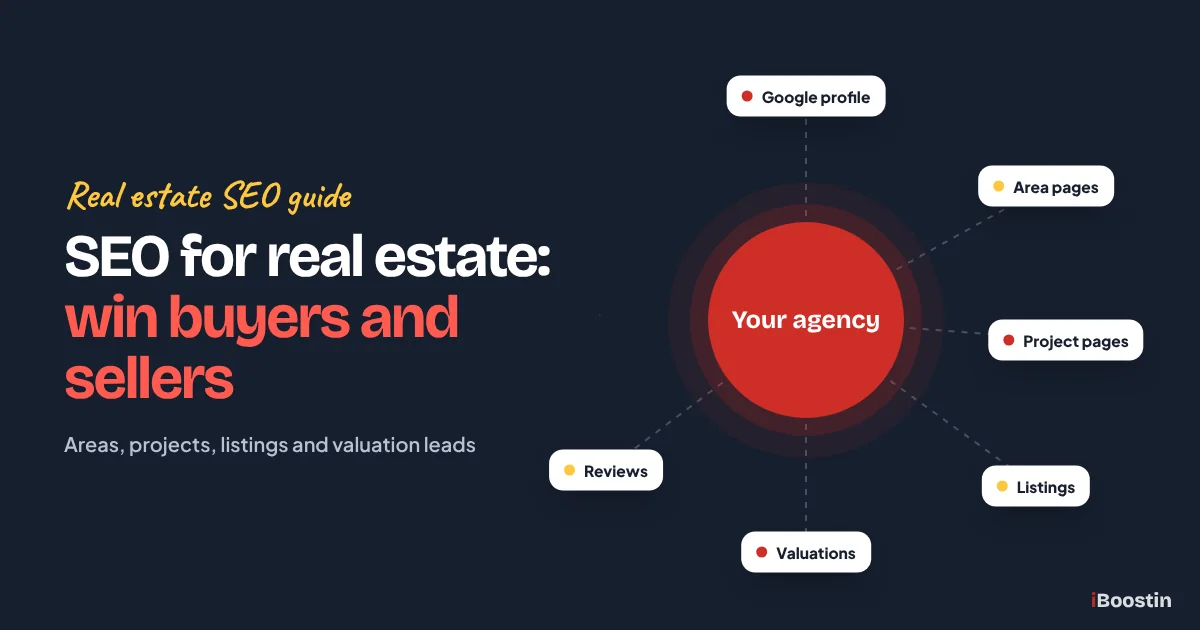
SEO for real estate is the work of getting your agency, brokerage or development in front of buyers, sellers and tenants when they search for property in your area. It covers your Google Business Profile, area and neighbourhood pages, listing and project pages that Google can index, content that answers buyer and seller questions, reviews, links from local sources and tracking that ties enquiries back to search.
Real estate is one of the hardest local markets in search. Large property portals take most of the top results for “apartments for sale” or “houses for rent” in almost every city, because they have millions of listings and years of authority. An agency trying to outrank them on those broad searches usually wastes months. The agencies that win in search do something different: they own the specific searches the portals answer badly, such as a particular neighbourhood, building, project, property type or seller question, and they own the map pack for their office.
This guide is the plan we use for real estate businesses, from independent agents and brokerages to developers launching a single project. It explains where to compete and where not to, how to build area and listing pages that rank, how to win sellers and landlords as well as buyers, and how to measure results in valuations and viewings rather than traffic. If you want the general version of this plan for any small business, our SEO for small business guide covers the foundations.
Key takeaways
- Do not fight the big property portals for broad searches. Win the specific ones: neighbourhoods, buildings, projects, property types and seller questions.
- Neighbourhood and community pages written from real local knowledge are the strongest long-term asset for an agency website.
- Listing pages only help SEO if Google can index them and each one has unique details, photos and a clear enquiry route.
- Sellers and landlords search differently from buyers. Valuation and “how to sell” content often brings the most valuable leads.
- Measure SEO in valuation requests, viewing bookings and qualified enquiries, not just rankings.
Why Real Estate SEO Is Different
Competing with property portals
Property portals dominate broad searches because they have enormous inventories, strong brands and thousands of links. When someone searches “two bedroom apartment for sale” plus a city name, Google usually shows portals because they offer the widest choice. A single agency, however good, rarely beats them there.
That does not mean SEO is pointless for agents. It means choosing the right battles. Portals are weak on depth: their neighbourhood descriptions are thin, they rarely explain what a building is like to live in, and they do not answer questions such as “is this area good for families” or “how long does it take to sell a house here”. Those are the searches where local expertise wins.
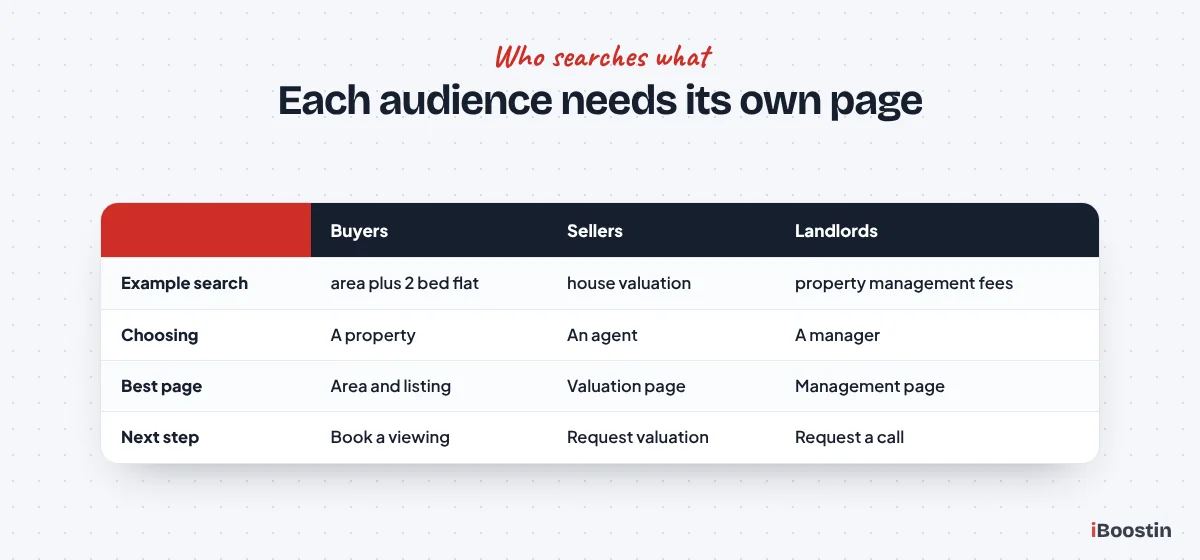
Buyers, sellers, tenants and landlords search differently
Buyers and tenants search for property types, areas, prices and features. Sellers and landlords search for valuations, selling costs, how long a sale takes, the best agent in an area and how to rent out a property. Developers’ buyers search for project names, payment plans and handover dates.
Each group needs different pages. An agency website that only lists properties for buyers misses the sellers and landlords, who are often the most valuable leads because they bring the stock that the business depends on.
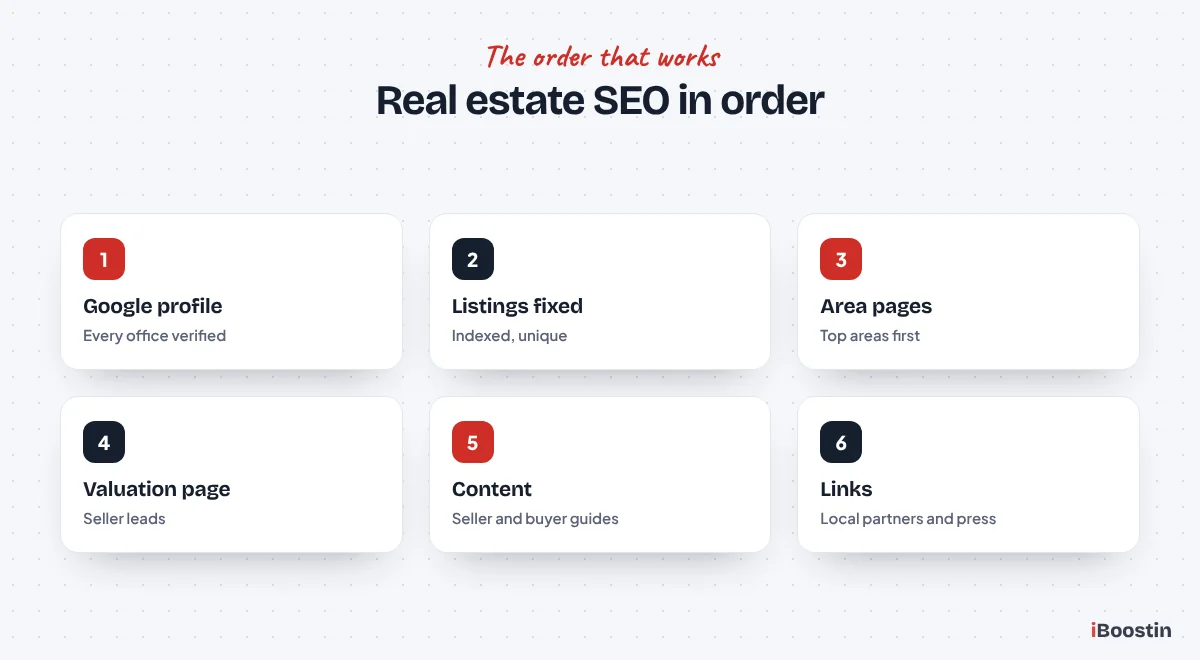
Set Up Your Google Business Profile Properly
Why the map pack matters for agents
Searches such as “real estate agent near me”, “estate agents” plus a town name or “property management company” show a map pack of three businesses. Sellers and landlords use these searches heavily, because they are choosing a firm, not a property. Appearing there with strong reviews puts you in front of people who are about to give an agency their business.
Each office needs its own verified profile with an accurate address, hours and phone number. Agencies working from a home office or without a public office need to follow Google’s rules for service-area businesses and hide the address where required, rather than inventing an office.
Categories, services and photos
Choose the primary category that best matches your main business, such as “Real estate agency”, “Real estate agent” or “Property management company”, and add secondary categories that genuinely apply. Fill in the services list with sales, lettings, valuations, property management and any specialities such as commercial or off-plan.
Upload photos of your office, your team and properties you have sold or let, with the owners’ permission. Post regularly about new listings, sold properties and market updates. A profile that shows recent activity looks like a busy, successful agency, which is exactly what sellers want to choose.
Neighbourhood and Community Pages
Why area pages are your strongest asset
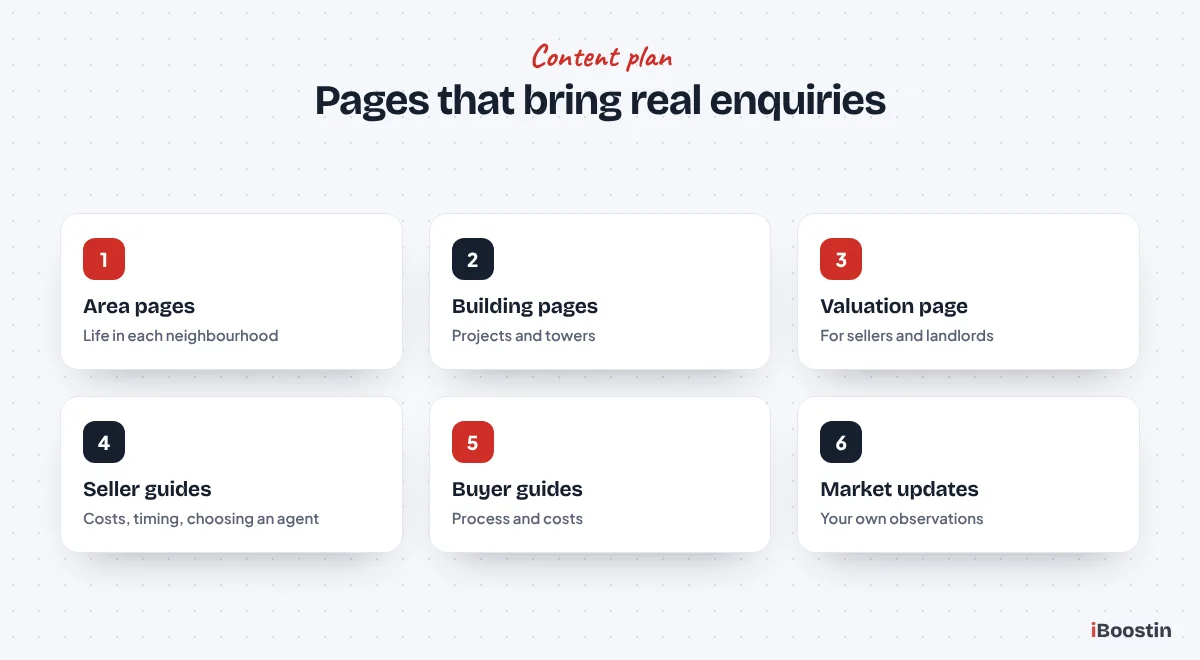
A detailed page for each neighbourhood, community or district you cover is the most valuable content an agency can publish. People research areas long before they pick a property, and they search for things like “living in” plus an area name, “best areas for families” in a city or “is” an area “safe”. Portals rarely answer these well, which leaves room for agents who know the streets.
Area pages also connect everything else on the site. They can link to current listings in the area, sold examples, buildings or projects nearby, market updates and your contact page. Over time they become the pages that earn links from local blogs, relocation guides and forums.
What a strong area page includes
Write about what it is actually like to live there: the type of homes, typical price ranges, schools, transport links, shops, parks, noise, parking and the kind of people who choose it. Add your own photos, a map, commute times to major employment areas and an honest summary of who the area suits and who it does not.
Include recent market observations from your own experience, such as how quickly homes are selling or which property types are most in demand, without inventing statistics. Finish with listings in the area and a clear prompt to book a viewing or request a valuation. Pages written from real knowledge read very differently from copied descriptions, and buyers can tell the difference.
Building and project pages
In cities with large apartment buildings or master-planned communities, a page for each major building or project captures searches for its name. Describe the developer, the year completed, unit types, amenities, service charges where you know them, parking, views and what residents say about living there.
For developers and off-plan agents, project pages are essential. Buyers search for the project name, the developer, payment plans and handover dates. A page that answers these clearly, with floor plans and a brochure download, can outrank portals that only show a listing card.
Listing Pages That Help Instead of Hurt
Make sure Google can index your listings
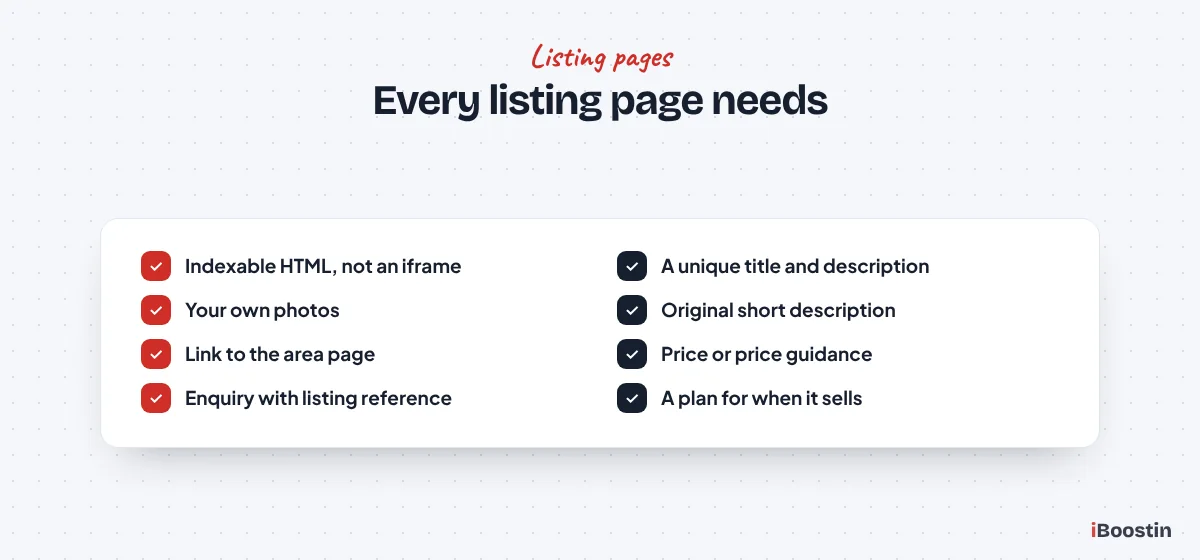
Many agency websites load listings from a feed inside a script or an iframe that Google cannot read properly. Others create listing pages that disappear the moment a property sells, leaving hundreds of broken links behind. Before investing in content, check in Search Console whether your listing pages are indexed and whether old ones return errors.
If your listings come from a property management system, ask the provider whether listing pages are crawlable, have unique titles and descriptions and use clean URLs. If they are not, consider whether the listings should live on your own site in a format Google can read.
Unique details on every listing
Listing pages often use the same developer description or portal text, so dozens of agents publish identical content. Add your own photos where possible, write a short original description of what makes the property special, mention the building or area with a link to its page and include practical details buyers care about.
Use real estate schema where your platform supports it, add clear prices or price guidance and include an enquiry form or WhatsApp button that captures the listing reference automatically. That way every enquiry tells you which property and which page brought it.
What to do with sold or let properties
Do not delete sold listings and leave broken pages. Either keep them live, marked as sold, with a link to similar available properties, or redirect them to the area page. Sold pages also act as proof for sellers, showing that your agency sells in that area, so many agencies keep a sold archive deliberately.
Whichever route you choose, apply it consistently. A site with hundreds of broken listing URLs wastes Google’s attention on dead pages and makes the whole site look poorly maintained.
Win Sellers and Landlords With Search
Valuation pages
Sellers and landlords search for valuations constantly: “house valuation” plus a town name, “how much is my property worth” or “rental valuation”. A dedicated valuation page with a simple request form, an explanation of how you value property and examples of recent sales in the area converts well, because the visitor is already thinking about selling.
Online valuation tools can help, but make clear that the figure is an estimate and that a proper valuation needs a visit. Sellers trust agents who are honest about the limits of automated numbers, and the follow-up visit is where the instruction is won.
Content that answers seller questions
Sellers ask practical questions before choosing an agent: how long it takes to sell, what fees and costs they will pay, whether to renovate before selling, the best time of year to list and how to choose an agent. Clear, honest articles on these topics bring visitors who are weeks or months away from instructing an agent.
Each article should link to the valuation page and to relevant area pages. Over time, this content builds the trust that makes a seller pick up the phone. It is also content that portals rarely produce well, which makes it easier to rank.
Landlord and property management content
Landlords search for property management fees, tenant screening, maintenance and legal responsibilities. If you offer management, a strong management service page plus guides for landlords can bring long-term, recurring business. Keep legal content general and accurate, and recommend professional advice for specific situations.
Show what landlords actually get: how tenants are found and checked, how rent is collected, how maintenance requests are handled and what reports the landlord receives. Landlords comparing managers want specifics, and a page that lists the process clearly usually converts better than one that only lists a fee.
Content for Buyers and Tenants
Buying and renting guides
Buyers research the process as much as the property. Guides on the buying process, costs on top of the price, mortgage basics, what to check at a viewing and how long a purchase takes all bring early-stage visitors. For tenants, guides on deposits, contracts and moving costs work the same way.
Write these guides for your market specifically. Buying rules, fees and timelines vary by country and city, and generic advice copied from another market can mislead readers and damage trust.
Market updates with your own observations
Short monthly or quarterly market updates for the areas you cover keep the site fresh and give sellers a reason to trust your knowledge. Share what you are seeing: which property types are moving quickly, how asking prices compare with achieved prices and what buyers are asking about. Avoid inventing statistics; your own observations are more useful and more credible.
Keep each update short and focused on one area or property type, and link it to the matching area page. Over a year, these updates build a record of local expertise that sellers can read before inviting you to value their home, and they give journalists a reason to quote you.
Reviews, Links and Local Authority
Reviews from buyers, sellers and landlords
Ask every client for a review when a sale completes, a tenancy starts or a management milestone passes. Sellers in particular read agent reviews closely, so detailed reviews that mention the area, the type of property and the outcome are valuable. Reply to every review, thank clients by name and handle complaints calmly.
Do not offer gifts or discounts for reviews and do not write reviews for clients. Genuine reviews spread steadily over time look far more trustworthy than a sudden burst.
Local links that matter
Real estate agencies can earn links from local news sites, community groups, schools, sports clubs, relocation guides and local business associations. Sponsoring local events, publishing genuinely useful area data or guides and commenting on the local property market for journalists all bring links that portals cannot easily copy.
Partnerships help too. Mortgage advisers, conveyancers, interior designers and removal companies often link to agents they work with, and you can link back where the relationship is genuine. Our guide on how to get backlinks for a new website explains safe ways to start.
Technical SEO for Property Websites
Speed and mobile experience
Property searches happen on phones, often while people are out viewing other properties. Listing pages with large image galleries, maps and embedded tours can become very slow. Compress images, lazy load galleries, limit heavy scripts and test your main page types with PageSpeed Insights.
Keep the call, WhatsApp and enquiry buttons visible on mobile. A buyer standing outside a property should be able to contact you in one tap.
Clean structure and filters
Search filters for price, bedrooms and property type can create thousands of near-duplicate URLs. Make sure filtered pages that add no unique value are not indexed, and that the important ones, such as an area plus property type, have proper titles, descriptions and some unique text. Use breadcrumbs and a clear menu so Google understands the relationship between areas, buildings and listings.
Plan your URL structure before the site grows. A simple pattern such as area, then property type, then listing makes it easy for Google and visitors to understand where they are, and it makes internal linking between areas, buildings and listings much easier to keep consistent.
SEO for Off-Plan Projects and New Developments
Launch pages before the launch
Buyers start searching for a new project as soon as its name appears in the news, on billboards or in developer announcements. If your project page is live early, with the confirmed details you are allowed to share, it can rank for the project name before the launch rush. Waiting until launch day means competing with every agent and portal at once.
Update the page as details are confirmed: unit types, payment plan, handover date, amenities and floor plans. Each update gives Google a reason to recrawl the page and gives buyers a reason to return. Collect registrations of interest with a short form, so early searchers become your first leads.
Answer the questions off-plan buyers ask
Off-plan buyers worry about different things from buyers of finished homes. They want to know about the developer’s track record, construction progress, payment plan milestones, what happens if handover is delayed and how resale works before completion. A section or article answering each of these honestly builds trust that a brochure alone cannot.
Keep construction updates on the page with dated photos where you have permission. Buyers searching for a project’s progress are often existing buyers or serious prospects, and a page that keeps them informed earns repeat visits and referrals.
Video, Virtual Tours and AI Search
Use video where it helps buyers decide
Short walkthrough videos and virtual tours keep buyers on a listing or area page longer and reduce wasted viewings. Host them on a video platform, embed them on the relevant page and give each one a clear title and description that matches the property or area. Video can also appear in search results for building and area searches.
Keep video files off your own server where possible, so listing pages stay fast. A tour embedded from a video platform loads only when the visitor presses play.
How AI tools recommend agents
Buyers and sellers increasingly ask AI assistants which agents to use in an area or what a neighbourhood is like. These tools lean on clear, consistent information: who the agency is, where it operates, what it specialises in, what reviews say and which areas it writes about with authority. Detailed area pages and strong reviews help here as much as they help normal search.
Check how AI assistants currently describe your agency and your main areas. If they name competitors or give outdated details, the fix is usually the same as for SEO: clearer pages, consistent listings and more genuine reviews.
Measure Real Estate SEO in Enquiries
The numbers worth tracking
Track valuation requests, viewing bookings, listing enquiries, calls and WhatsApp messages from organic search, and note which page each came from. In Search Console, watch impressions and clicks for area, project and seller searches. In your profile insights, watch calls, website clicks and direction requests.
Ask new clients how they found you and record the answer in your CRM. A seller who read three of your area pages before requesting a valuation is the best proof that the work is paying off, even if the last click came from somewhere else.
How long it takes
Profile improvements and reviews can lift map pack visibility within weeks. New area and project pages usually start ranking within two to four months, depending on competition and the authority of your site. Seller content and links build more slowly but compound over time. Keyword research is the step that decides which pages are worth building first; our guide on keyword research for small business explains how to do it without paid tools.
Agencies that already have an established domain, some reviews and a few local links tend to see results faster than new brands. If your website is new, expect the first months to be about building trust: profile, reviews, a handful of excellent area pages and the first local links.
Real Estate SEO in Different Markets
Agents in large cities
In big cities, competition for every area search is intense, and several agencies may already have good neighbourhood pages. Go narrower: individual streets known by name, specific buildings, school catchment areas or property types such as townhouses, penthouses or studio apartments near a university. Narrow pages are easier to make excellent and usually bring enquiries that are closer to a decision.
Big-city agencies also benefit from multilingual pages where buyers come from abroad. If many of your buyers search in another language, a properly translated and localised area page can rank with far less competition than the English version.
Agents in smaller towns
In smaller towns, the opportunity is the opposite. There may be only a few agencies, and many of them have thin websites. A complete Google profile, strong reviews and a handful of detailed pages about the town and its villages can be enough to dominate local searches within a few months.
Smaller-town agents should also cover the wider area buyers consider, such as nearby villages and commuter towns, because buyers moving from cities often search for the region rather than one town.
Common Real Estate SEO Mistakes
Chasing portal keywords
Trying to rank for broad searches such as “property for sale” in a major city usually fails against portals. The time is better spent on neighbourhoods, buildings, projects and seller questions where your local knowledge gives you an edge.
Check what currently ranks before choosing a target. If the first page is entirely portals and directories, pick a more specific search that real agency pages can win.
Copying developer and portal text
Publishing the same description that dozens of other agents use gives Google no reason to rank your page. Rewrite descriptions, add your own photos and connect each listing to your area knowledge.
Even two or three original sentences per listing, plus links to the area and building pages, make a listing noticeably more useful than the copies elsewhere.
Forgetting the map pack
Many agencies invest in a beautiful website and ignore their Google profile. For sellers and landlords choosing an agent, the profile and reviews often matter more than the website itself.
Treat the profile as a second homepage: keep it current, post on it and make sure every office has its own complete listing.
Doing It Yourself vs Getting Help
What your team can handle
Agents and administrators can manage the Google profile, collect reviews, take photos, write short market updates and add local knowledge to area pages. These tasks fit naturally into daily work and make the biggest difference to trust.
Agree who owns each task and set a simple monthly checklist, so the profile, reviews and updates do not slip when the office gets busy.
Where a specialist helps
Technical fixes for listing feeds, site structure, filters, schema, keyword research and link building usually need specialist time. If your agency covers several areas or launches projects regularly, a monthly plan keeps the work moving. Our monthly SEO services cover this with a written task list each month, and our SEO services page explains how we plan work for competitive local markets. For the map pack specifically, our guide on how to rank higher on Google Maps is a good place to start.
A good partner will start by mapping the searches you can realistically win, not by promising first place for the biggest terms. Ask how they plan to handle listings, how they will measure valuations and enquiries and who will own the content and accounts if you part ways.
Frequently Asked Questions About SEO for Real Estate
Can a real estate agency outrank property portals?
Rarely on broad searches, but often on specific ones. Neighbourhood, building, project and seller searches are where agencies with real local knowledge can beat portals, because portals answer those searches poorly.
What is the most important SEO page for an estate agent?
For most agencies, detailed neighbourhood pages and a strong valuation page. Area pages attract buyers and sellers researching locations, and the valuation page captures sellers ready to act.
Do listing pages help real estate SEO?
Only if Google can index them and each one has unique content. Listings loaded in scripts or copied from portals add little, and deleted listings create broken links.
How do I get more seller leads from Google?
Build a clear valuation page, publish honest content answering seller questions and keep your Google profile active with strong reviews. Sellers search for agents and valuations, not for listings.
How long does real estate SEO take?
Profile and review work can help within weeks. Area and project pages usually start ranking within two to four months, while competitive cities and broader terms take longer.
Should developers do SEO for a single project?
Yes. A dedicated project page with floor plans, payment plans, location details and handover information can rank for the project name and capture buyers researching it.
Is SEO or paid advertising better for real estate?
Ads bring immediate enquiries for launches and urgent listings. SEO builds lasting visibility for areas, projects and seller searches. Most agencies get the best results using both.
Compete Where Your Knowledge Wins
Real estate SEO rewards agencies that stop chasing the portals and start publishing what only a local agent knows: what each street is like, how each building feels to live in, how fast homes sell and what sellers should expect. Build those pages, keep your Google profile busy, collect honest reviews and measure the valuations and viewings that follow. If you want a second opinion on which searches your agency could realistically win, send us your website and we will tell you where we would start.