In this guide
- Why a New Website Needs Backlinks
- What Makes a Good Backlink?
- Your First 15 Links: Quick Foundations
- The Next 35 Links: Earn Them From Your Community and Industry
- Create Pages Other Sites Want to Link To
- Backlinks for a New Online Store
- Links to Avoid on a New Website
- How Many Backlinks Does a New Website Need?
- How Long Do Backlinks Take to Work?
- Do It Yourself or Get Help?
- Frequently Asked Questions About Backlinks for a New Website
- Earn Links the Way Real Businesses Do
To get backlinks for a new website, start with links you already deserve: your Google Business Profile, social profiles, trusted directories, suppliers, partners and industry associations. Then earn links from your local community, journalists and useful resources you publish. Avoid bought link packages, which can get a new site penalized before it ever ranks.
A new website without backlinks is like a new shop on a street nobody walks down. The building can be perfect, but Google has no reason to send people there yet. In Search Console, it looks like this: impressions start to appear after a few weeks, but the pages sit on page five or six and clicks barely move. Content alone rarely fixes that. What the site is missing is evidence that other real websites know and trust it.
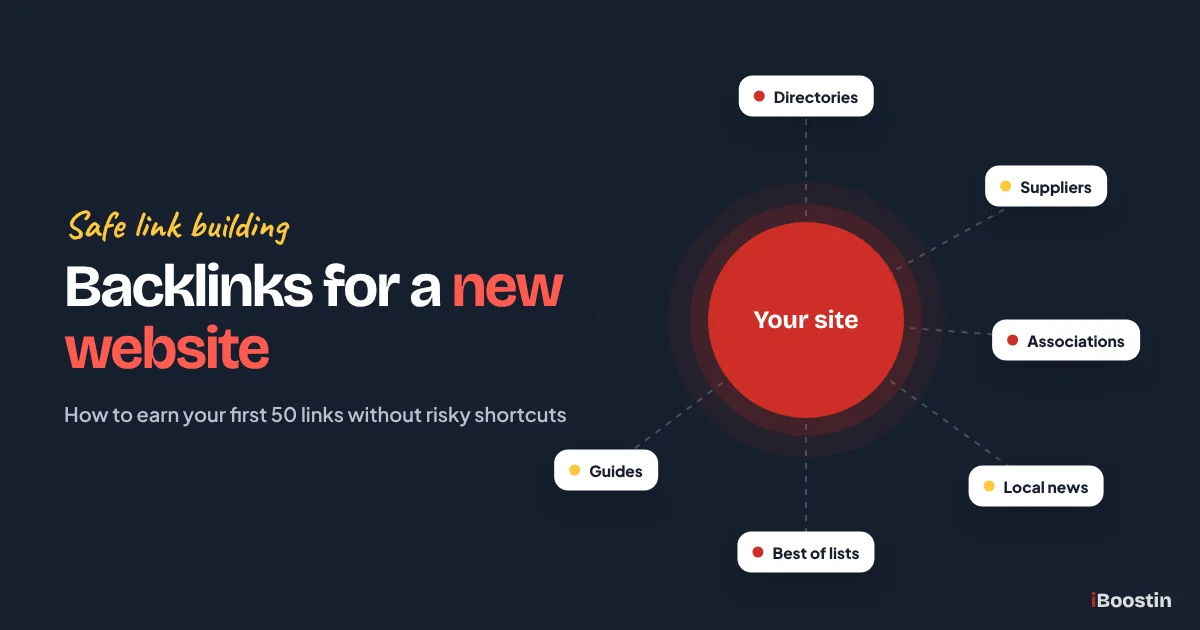
This guide shows the order we use at iBoostin to build the first fifty links for new small business websites, starting with links that take an afternoon and moving toward the ones that take real effort. Every method here is safe under Google’s spam policies. If you are new to how links fit into the bigger picture, our guide to SEO for small business explains where authority sits in the overall plan.
Key takeaways
- New websites stall on page five or six mostly because they have no links, not because their content is bad.
- Start with links you already qualify for: business profiles, directories, suppliers, partners and associations. These take hours, not months.
- The links that move rankings most come from relevant, trusted sites: local news, industry publications, partners and genuine resources.
- A handful of good links beats hundreds of weak ones. Bought link packages and link exchanges risk a penalty.
- Track new links in Search Console and give them time. Rankings usually respond over weeks to months, not days.
Why a New Website Needs Backlinks
A backlink is a link from another website to yours. Google treats it as a kind of recommendation: when a trusted site links to you, it suggests your page is worth visiting. For a new website with no history, links are one of the few signals that tell Google other people know your business exists.
Links Are How Google Measures Trust
Google ranks pages on relevance, quality and trust. You control relevance and quality on your own pages, but trust has to come partly from outside. Links from respected websites, mentions of your brand and reviews from customers all show Google that your business is real and valued. A new site starts with none of these.
That is why two pages with similar content can rank very differently. The one with a few relevant links from trusted sites usually wins. In our experience with new small business sites, the first meaningful jumps in position usually come after the first good links are earned, not after more content is published.
Why Content Alone Is Not Enough
Many owners publish more and more blog posts hoping to rank, while the site has no links at all. Google sees the new pages, tests them on low positions and leaves them there, because nothing outside the site vouches for them. More content on an untrusted site mostly produces more impressions without clicks.
Content and links work together. Strong pages give other sites a reason to link, and links give strong pages the trust to rank. A new site needs both, in that order: a few genuinely useful pages first, then a steady effort to earn links to them.
What Makes a Good Backlink?
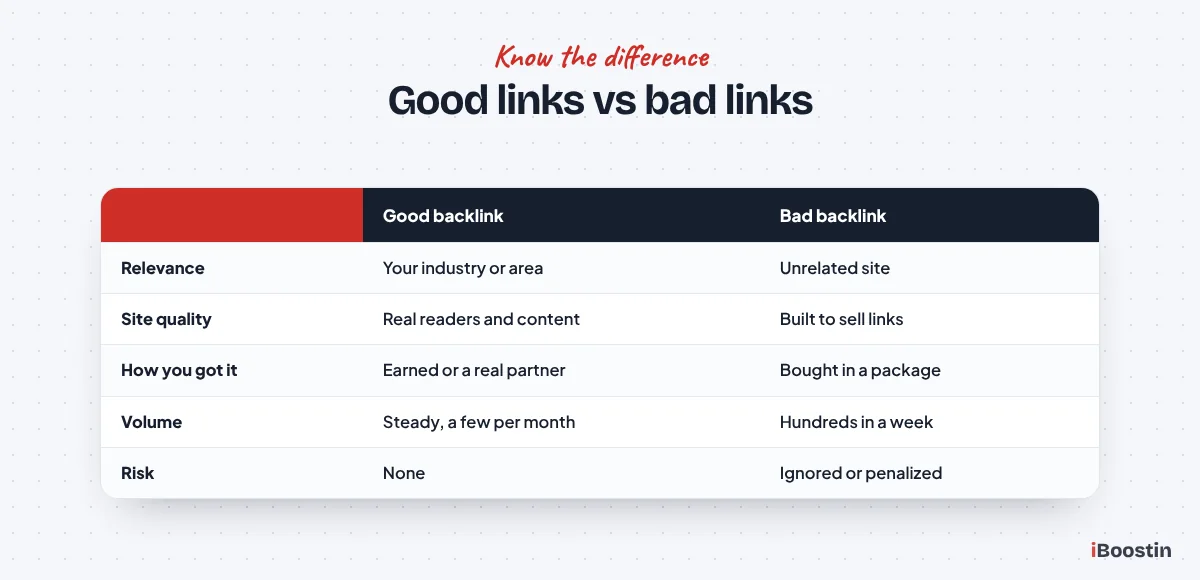
Not all links are equal. One link from the right site can do more than a hundred from the wrong ones. Before you start, it helps to know what Google values, so you spend your time on links that matter.
Relevance Comes First
A link from a site related to your industry or your area tells Google much more than a link from an unrelated site. A plumbing supplier linking to a plumber, a local chamber of commerce linking to a local accountant, an industry magazine linking to a specialist: these make sense, and Google can see that they make sense.
A link from a random website about something unrelated carries little weight, even if that site looks big. When you evaluate any link opportunity, ask whether a real customer might reasonably click that link and find your business useful. If the answer is yes, it is probably a good link.
Trust and Real Traffic
Good links come from websites that real people visit and that Google already trusts: established businesses, organizations, publications and well-maintained directories. Sites that exist only to sell links usually have little real traffic, publish anything for a fee and link out to hundreds of unrelated businesses.
Look at a site before you pursue a link from it. Does it have real content written for readers? Does it rank for anything? Would you be comfortable showing it to a customer? If not, the link is unlikely to help and may hurt.
Earned, Not Bought
Google’s spam policies treat buying links that pass ranking credit, large-scale link exchanges and links from networks built for SEO as link spam. Its systems are designed to ignore these links, and manual actions can remove a site from results. For a new site, that can mean months of lost progress.
Paid relationships are fine when they are disclosed and the link is marked as sponsored, such as an advertisement or a sponsored listing. What you want to avoid is paying specifically for a followed link to manipulate rankings. Every method in this guide earns links through real relationships or real value.
Your First 15 Links: Quick Foundations
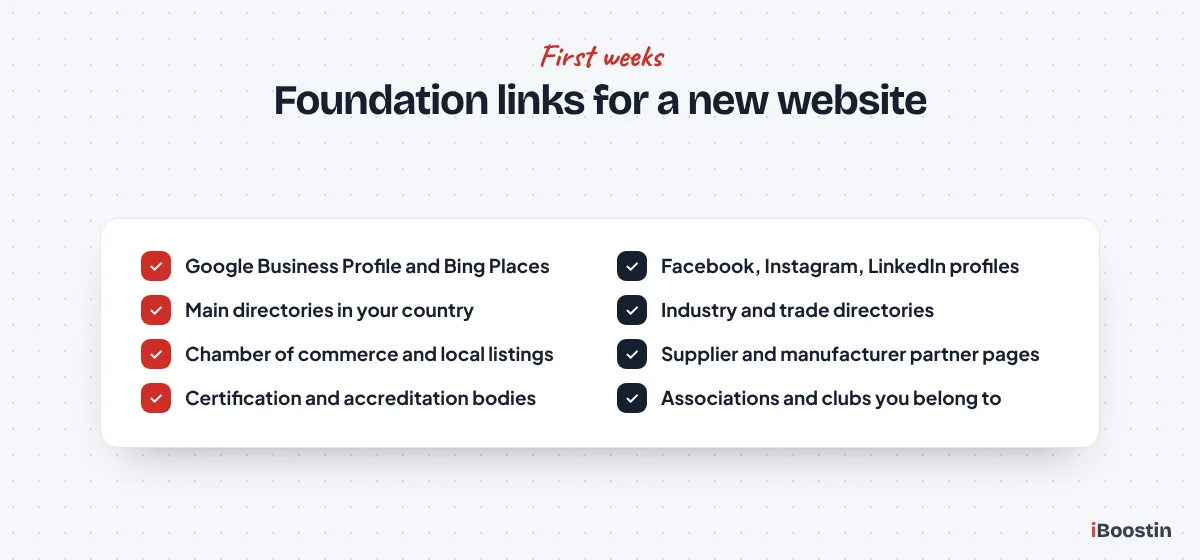
These links take hours, not months, and most new businesses already qualify for them. They will not make you rank on their own, but they establish your business across the web, help Google and AI tools understand who you are and give the rest of your link building a base.
Business Profiles and Social Accounts
Create and complete your Google Business Profile and Bing Places listing, with your website link, accurate details and real photos. Set up profiles on the social platforms your customers use, such as Facebook, Instagram and LinkedIn, and add your website to each. If you sell to businesses, a complete LinkedIn company page matters.
Many of these links do not pass much ranking credit directly, because platforms often mark outbound links as nofollow. They still help: they confirm your business entity, send some visitors and give Google and AI tools consistent information about you. Our guide on how to rank higher on Google Maps covers the Business Profile in detail.
Trusted Directories in Your Industry and Area
Submit your business to the main general directories in your country and to the directories specific to your industry, such as trade bodies, professional registers and review platforms your customers use. Add local directories like your chamber of commerce, council business listings and local business associations.
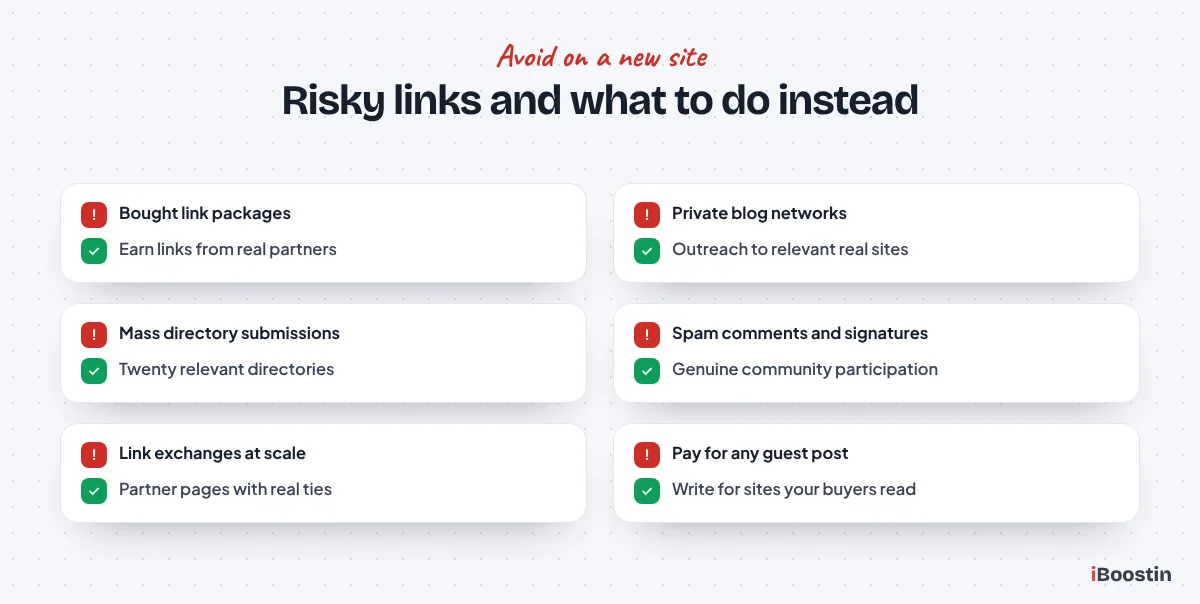
Quality matters more than quantity here. Twenty relevant, well-maintained directories are worth more than five hundred low quality ones, and bulk directory submission services often place you on sites nobody visits. Keep your business name, address and phone number identical on every listing.
Suppliers, Manufacturers and Certifications
Many suppliers and manufacturers have “where to buy”, “approved installer” or “partner” pages that link to businesses they work with. If you use a brand’s products, hold a certification or are an approved installer, ask to be listed. These links are highly relevant and come from established sites.
The same applies to software and tools you use if they have customer showcases, and to accreditation bodies if you hold their certifications. A short, polite email explaining your relationship is usually all it takes. In our client work, supplier and certification pages are often the strongest early links a new site gets.
Associations, Clubs and Partners
Industry associations, trade bodies and professional groups often list members with links. So do local business groups, networking clubs and charities you support. Join the ones that are genuinely useful to your business and make sure your member profile links to your site.
Think about businesses you work alongside: an electrician who refers clients to a plumber, a web designer who works with an accountant. Partner pages and recommended supplier lists create relevant links in both directions when the relationship is real. Avoid swapping links at scale with businesses you have no connection to.
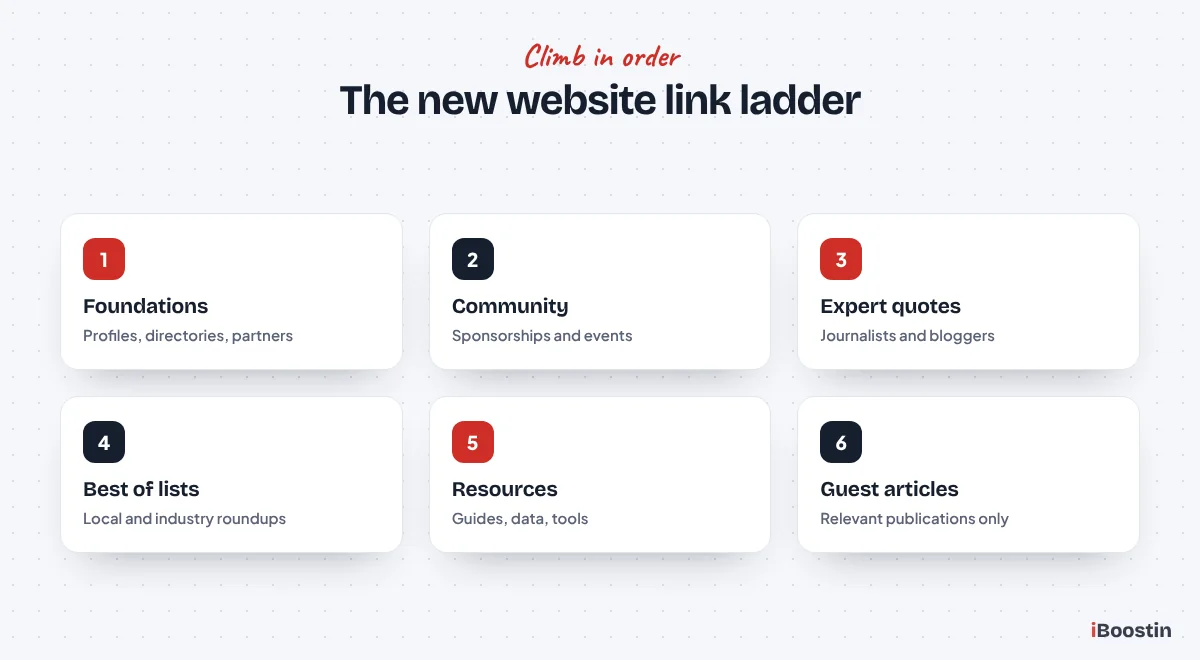
The Next 35 Links: Earn Them From Your Community and Industry
Once the foundations are in place, the links that really move rankings come from relevant websites choosing to mention you. These take more effort, but each one carries far more weight than a directory listing.
Local Sponsorships, Events and Community Work
Sponsor a local sports team, school event, charity run or community project. Most of them thank sponsors on their website with a link. Host or speak at a local event, workshop or meetup, and the organizers usually link to speakers. Offer a discount to members of a local organization and ask to be included on their member benefits page.
These links are relevant to your area, which matters a lot for local SEO, and they come with real community goodwill. Choose causes and events you genuinely care about, so the relationship lasts beyond a single link.
Expert Quotes for Journalists and Bloggers
Journalists and bloggers constantly look for expert comments for their articles. Several platforms connect them with expert sources. You sign up, receive requests in your field and reply with a short, useful answer. When your quote is used, you are often credited with a link to your website.
Answer only requests where you have real expertise, reply quickly and keep your comment specific and quotable. Local news sites also welcome stories about local businesses: a new service, a milestone, a community project or useful seasonal advice. One article on a respected news site can be one of the strongest links a small business ever gets.
Get Included in “Best of” Lists
Search for lists like “best accountants in Manchester”, “top web design agencies in Dubai” or “best tools for contractors”. Many of these lists are on blogs and local sites that update them regularly. Contact the authors politely, explain why your business fits and offer anything that makes their job easier, such as accurate details or a short description.
These lists matter twice. They bring links and referral visitors, and they are exactly the kind of source AI tools read when recommending businesses. We explain that side in how to get your business mentioned in ChatGPT.
Turn Brand Mentions Into Links
As your business becomes known, other sites will mention your name without linking: a news article, a supplier’s case study, a local blog. Search your business name regularly, and set up an alert for it. When you find a mention without a link, contact the site, thank them and ask if they would add a link to help readers find you.
Many will say yes, because the mention already shows they value your business. It is one of the easiest ways to earn links from sites that already know you, and it takes only a short email.
Create Pages Other Sites Want to Link To
Some links you ask for. The best ones come to you because you published something worth referencing. For a small business, that does not mean big research reports. It means one or two genuinely useful resources in your field.
Useful Guides and Local Resources
Think about questions your customers and other businesses ask repeatedly. A clear guide to permits for home renovations in your city, a checklist for moving offices, a seasonal maintenance guide or a glossary of terms in your industry can attract links from blogs, forums and local sites that want to point their readers to a good answer.
Make it the best version of that resource online: specific, accurate, easy to read and kept up to date. Then tell the people who would find it useful, such as local bloggers, community groups and associations. Good resources keep earning links for years after they are published.
Original Data, Photos and Tools
Original information attracts links because others cannot get it anywhere else. A simple survey of your customers, data from your own jobs, before and after photos or a basic calculator can all become reference points. Journalists and bloggers link to the source of a statistic or image they use.
Keep it honest and simple. Publish your method, use real numbers and do not overstate what the data shows. Even a small, well presented piece of original data can earn links from sites that would never link to a standard service page.
Guest Articles on Relevant Websites
Writing an article for an industry publication, a partner’s blog or a respected local site gets your expertise in front of a new audience and usually includes a link to your website. Choose sites your customers actually read, and offer a topic that helps their readers rather than promoting your services.
Avoid sites that publish anything for a fee, accept articles on every topic or exist mainly to sell guest posts. Those links carry little value and fall under the link schemes Google warns about. A few articles on genuinely relevant sites are worth far more than many on generic blogs.
Backlinks for a New Online Store
Autocomplete shows many people asking how to get backlinks for an ecommerce website. Online stores face a particular problem: product and category pages are rarely something other sites want to link to on their own. The approach shifts slightly, but the principles stay the same.
Use Your Products and Brands
If you stock products from known brands, ask whether they list authorized retailers or stockists on their website. If you make your own products, reach out to bloggers, reviewers and niche publications that cover your category, and offer samples for honest reviews with clear disclosure. Gift guides published before holidays are another common source of relevant links for stores.
Product photos, size guides and care instructions that are better than anything else online can also attract links from forums and blogs that answer customer questions. Make those resources easy to find and easy to reference.
Link to Category Pages From Strong Content
Most links to an online store land on the homepage or on helpful guides rather than on product pages. That is fine. Use internal links to pass that authority on: link from your guides and homepage to the category pages you want to rank, with descriptive anchor text.
A buying guide that ranks and earns links can lift several category pages at once through internal links. For many small stores, two or three excellent guides do more for category rankings than chasing links to individual products.
Links to Avoid on a New Website
New sites are especially vulnerable, because they have little positive history to balance any bad signals. These are the link sources we steer every new client away from.
Bought Link Packages and Private Blog Networks
Offers of hundreds of backlinks for a fixed package, guaranteed domain authority or links from “high authority” sites almost always come from private blog networks or link farms. These are groups of sites built only to sell links. Google’s systems are designed to detect and ignore them, and they can lead to manual actions.
At best, you pay for links that do nothing. At worst, your new site is penalized and you spend months cleaning up. If an offer promises a number of links rather than describing where they come from and why those sites would link to you, walk away.
Spam Comments, Forum Signatures and Mass Directories
Dropping links in blog comments, forum signatures and profile pages on unrelated sites used to be common. Today these links are almost always nofollow, ignored or treated as spam. Mass submission to hundreds of low quality directories has the same problem.
Some people ask about getting links from Reddit or Wikipedia. Those sites mark outbound links as nofollow, and posting links just for SEO gets removed quickly. Genuine participation in communities where your customers gather can still help your brand and your visibility in AI answers, but treat it as reputation building, not link building.
How Many Backlinks Does a New Website Need?
There is no fixed number. It depends on how many links the pages ranking for your keywords have, and how relevant and trusted those links are. A local service business in a small town may move up with a handful of good local links, while a national competitive search can need many more.
Look at What Competitors Have
Check the pages ranking in the top three for your main keywords. Paid tools like Semrush and Ahrefs show how many websites link to each one. If the top pages have links from a dozen relevant sites, that is roughly the level you need to compete, combined with a page that is at least as good.
Focus on the number of different websites linking to you, not the total number of links. Ten links from one website count far less than one link each from ten different relevant websites. Quality and relevance still outweigh raw numbers.
Build Steadily, Not in Bursts
A new site that gains a few good links every month looks natural. A site that suddenly gains hundreds of links in a week, then nothing, looks like it bought them. Steady, consistent link building is both safer and more effective over time.
Plan a monthly target you can sustain, such as a few new directory or partner links plus one or two stronger links from outreach, PR or content. Over six to twelve months, that adds up to a strong profile for most small business markets.
How Long Do Backlinks Take to Work?
New links usually take a few weeks to a few months to affect rankings. Google first has to find the linking page, then recrawl and reassess your page. Strong, relevant links often show an effect within one to three months, especially for pages already sitting on page two.
Track Your Links in Search Console
Search Console’s Links report shows which external sites link to you and which of your pages receive the most links. It updates slowly and does not show every link, but it is free and comes straight from Google. Check it monthly to confirm your new links are being found.
Keep your own spreadsheet as well: the date, the linking site, the page it links to and how you earned it. Comparing that list with your Search Console Performance report shows which links coincide with ranking improvements, and helps you focus on the methods that work best in your market.
Give It Time and Keep Going
Link building compounds like the rest of SEO. The first links establish trust, later links build on it, and each new page benefits from the authority the site already has. Stopping after a couple of months means most of the benefit never arrives.
Our guide on how long SEO takes explains where link building fits in a realistic timeline for a new site. In most cases, the second half of the first year is when steady link building turns into clear ranking gains.
Do It Yourself or Get Help?
A small business owner can earn the foundation links and many community links personally, because they come from relationships the owner already has. Where help becomes valuable is the steady outreach, PR and content work that earns stronger links month after month.
What You Can Do Yourself
Complete your profiles, submit to the main directories, ask suppliers and associations for listings, and sponsor or join local organizations you care about. Answer a few journalist requests each month in your area of expertise. These steps cost little and build a solid base over the first few months.
Keep a simple list of every link you earn and every request you send. Even a few hours a month, done consistently, puts a new small business ahead of competitors who never think about links at all.
When to Bring in Specialists
Bring in help when your market is competitive, when you need links from publications and industry sites you have no relationship with, or when you simply do not have time for outreach. Specialists know which sites accept contributions, how to pitch editors and how to spot risky opportunities.
Our link building services and off-page SEO services earn links through outreach, digital PR and partner relationships, with every link listed in your report. For a complete plan that includes pages and technical work, see our SEO services.
Frequently Asked Questions About Backlinks for a New Website
How do I get backlinks for a new website for free?
Start with your Google Business Profile, social profiles and the main directories for your country and industry. Ask suppliers, manufacturers, associations and partners to list you. Answer journalist requests, get involved in local events, ask sites that mention your business to add a link and publish one genuinely useful resource others want to reference.
How many backlinks does a new website need to rank?
There is no fixed number. Look at how many different websites link to the pages ranking in the top three for your keyword. That gives a rough target. For many local searches, a handful of relevant local and industry links plus strong pages is enough to compete. National or competitive searches need more.
Are directory links still useful?
Relevant, well maintained directories are still useful, especially for local businesses: they confirm your business details and some pass ranking value. Mass submissions to hundreds of low quality directories are not useful and can look spammy. Choose the main general, industry and local directories your customers actually use.
Is it safe to buy backlinks?
Buying links that pass ranking credit breaks Google’s spam policies. Google’s systems are designed to ignore these links, and manual actions can remove pages from results. Paid placements are fine when they are disclosed and marked as sponsored, but they should not be bought to manipulate rankings. Earned links are safer.
How long do backlinks take to improve rankings?
Usually a few weeks to a few months. Google needs to find the linking page and reassess your page. Pages already ranking on page two often respond fastest. Strong, relevant links tend to show an effect within one to three months, and the overall benefit builds as you keep earning links.
Do links from Reddit or Wikipedia help SEO?
Links from Reddit and Wikipedia are nofollow, so they pass little direct ranking credit, and posting links just for SEO gets removed. Genuine participation in communities where your customers are can still build your brand, send visitors and help AI tools learn about your business. Treat it as reputation, not link building.
What is the difference between dofollow and nofollow links?
A followed link can pass ranking credit to the page it points to. A nofollow link, marked with a rel attribute, tells Google not to treat it as an endorsement, though Google may still use it as a hint. Sponsored and user-generated links should be marked accordingly. A natural link profile contains both types.
Earn Links the Way Real Businesses Do
The fastest way to build backlinks for a new website is not a shortcut. It is doing what real businesses already do: listing yourself where customers look, working with suppliers and partners, joining your community, helping journalists and publishing something useful. Each of those creates a link with a real reason behind it, which is exactly what Google wants to reward.
Start with the foundation links this week, then add a few community and industry links every month. If you would rather have a team handle the outreach, we can build relevant links for your site and show you every one of them.