In this guide
- Why Getting Mentioned in ChatGPT Matters
- How ChatGPT and AI Search Decide Which Businesses to Mention
- Step 1: Let AI Tools Reach and Read Your Website
- Step 2: Describe Your Business Clearly and Specifically
- Step 3: Make Your Business Details Consistent Everywhere
- Step 4: Earn Reviews That Describe What You Do Well
- Step 5: Get Mentioned on Trusted Third-Party Sites
- Step 6: Track Whether AI Tools Mention You
- What Matters Most for Different Types of Business
- Common Mistakes That Keep Businesses Out of AI Answers
- Can You Pay to Be Mentioned in ChatGPT?
- Getting Help With AI Search Visibility
- Frequently Asked Questions About Getting Mentioned in ChatGPT
- Make Your Business Easy to Recommend
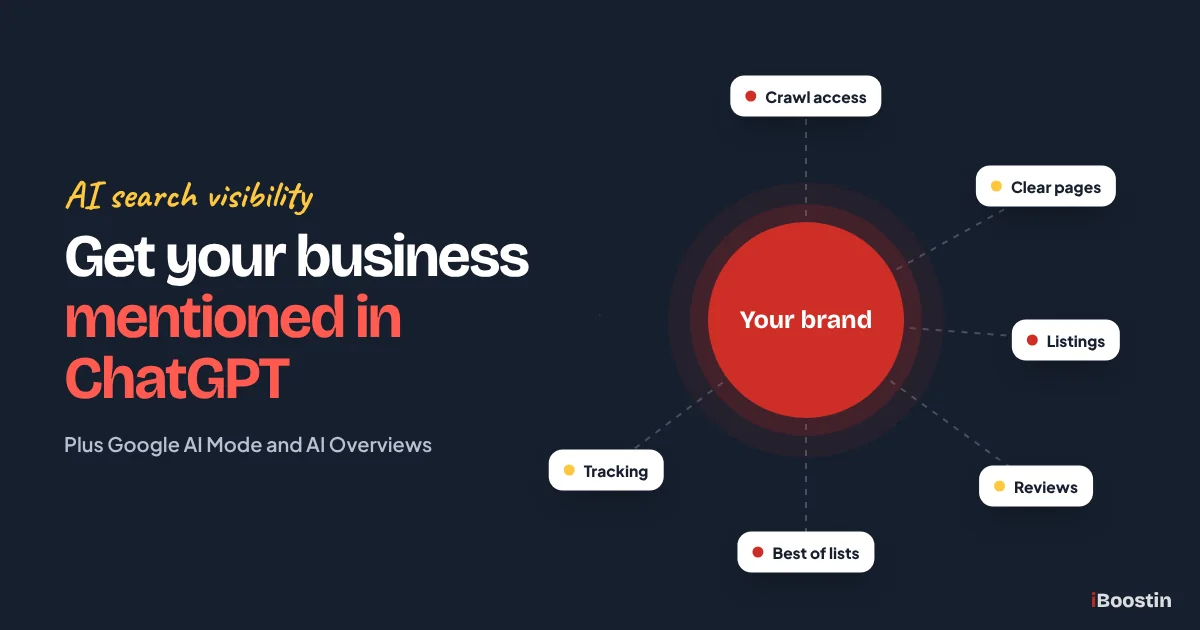
To get your business mentioned in ChatGPT, Google AI Mode and AI Overviews, make it easy for AI tools to find, understand and trust you: let their crawlers reach your site, describe clearly what you do and where, keep your business details consistent everywhere, collect genuine reviews and earn mentions on trusted sites, especially “best of” lists in your field.
Here is the situation many owners find themselves in. They ask ChatGPT for “the best accountant for small businesses in Dubai” or “a good roofer near Leeds”, and three or four competitors get named. Their own business, with good reviews and years of experience, is not mentioned at all. It feels random, but it is not. AI assistants recommend the businesses they have the most consistent, trustworthy information about.
This guide explains how AI tools decide which businesses to name, then gives you the step by step process we use at iBoostin to improve a small business’s visibility in AI answers, plus how to check whether it is working. Most of it builds on normal SEO, so if you are new to that, our guide to SEO for small business is a good starting point.
Key takeaways
- AI tools mention businesses they can verify in several places, such as your website, business listings, reviews and third-party articles.
- Make sure AI crawlers such as OAI-SearchBot and Googlebot can reach your site, and that your key pages answer questions clearly.
- Consistent business details across Google, Bing, Apple and industry directories make your business easier to recognize.
- “Best of” lists, local news, industry sites and genuine community discussions are among the strongest signals for being recommended.
- You cannot pay to be placed inside AI answers. Track visibility by asking the same questions every few weeks.
Why Getting Mentioned in ChatGPT Matters
More people now ask AI assistants for recommendations instead of scrolling through search results. They ask conversational questions, like “who is a reliable electrician in Austin for an old house”, and get a short answer with a few names. If your business is not one of those names, you are not part of that decision at all.
AI Answers Shorten the Shortlist
A normal search results page shows ads, a map with three businesses and ten organic results. A customer might look at several of them. An AI answer often names three to five businesses with a short reason for each. That shortlist is much smaller, so being on it matters more than being somewhere on page one used to.
The people asking these questions are often close to a decision. They have described their situation and want a recommendation. In our client work, we see enquiries that start with “ChatGPT recommended you” becoming more common, especially for professional services and local businesses with strong reviews.
It Builds on SEO, It Does Not Replace It
Getting mentioned in AI answers is sometimes called generative engine optimization, or GEO, and AI SEO. The name is new, but most of the work is not. AI tools rely heavily on the same things that help you rank on Google: clear pages, a strong Google Business Profile, reviews and links and mentions from trusted sites.
Google has said that its AI features use the same core signals as normal search, and that there is no special trick needed beyond good SEO practices. ChatGPT’s search feature also pulls information from the web. So the businesses that do SEO well tend to show up in AI answers too, and the extra steps below build on that base rather than replacing it.
How ChatGPT and AI Search Decide Which Businesses to Mention
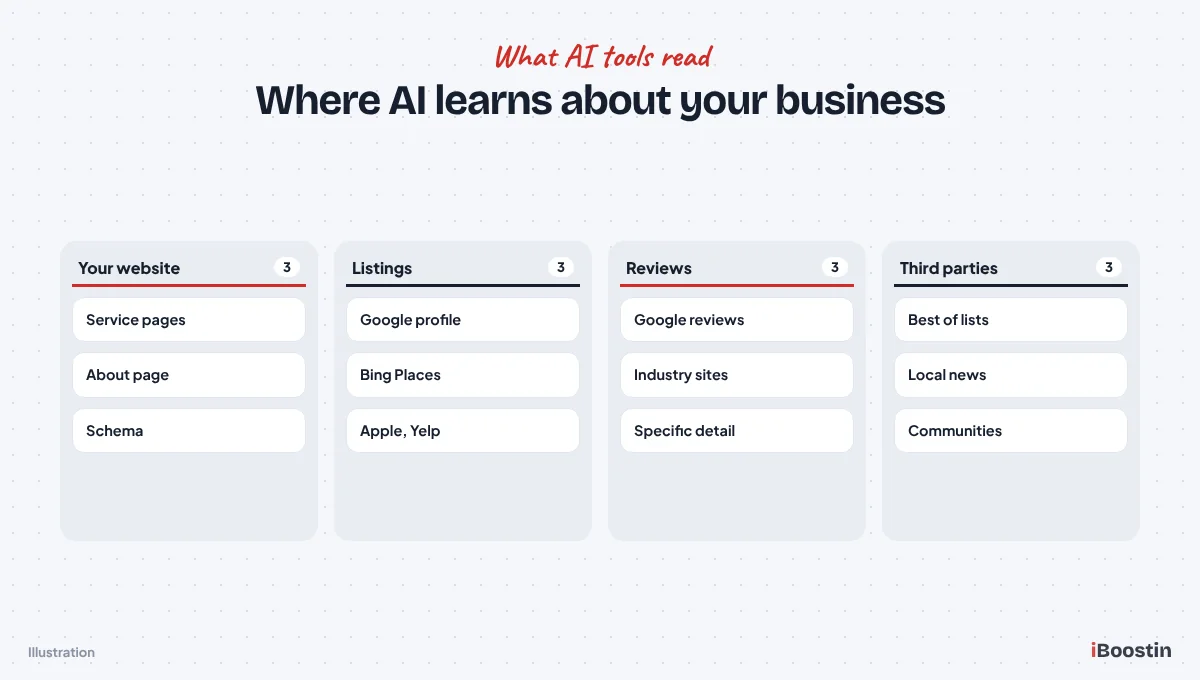
AI assistants do not have a list of approved businesses. They put together an answer from the information they can access, and they lean toward businesses that several independent sources describe in the same way. Understanding where that information comes from tells you where to focus.
Training Data and Live Web Search
AI models learn from huge amounts of text gathered before a cutoff date. That background knowledge favors businesses that were already mentioned widely online. On top of that, ChatGPT search, Google AI Mode and AI Overviews can search the web in real time and read current pages, which is how newer information and newer businesses can appear.
For a small business, live search is the bigger opportunity. You cannot change what a model learned last year, but you can make sure that when it searches today, it finds clear, consistent, trustworthy information about you. That is where most of the steps in this guide make a difference.
Corroboration From Several Sources
When an AI recommends a business, it is more confident when several independent sources agree: the business website says it specializes in something, review sites show customers praising that specialty, and a local article or industry list mentions it. One source alone, especially your own website, is weaker evidence.
This is why reviews and third-party mentions carry so much weight. A business that only describes itself well on its own website is easy to overlook. A business that other sites, lists and customers describe consistently is easy to recommend.
Clear Answers AI Can Quote
AI tools favor content that answers a question directly and clearly. A page that starts a section with a one or two sentence answer, uses descriptive headings and includes specific facts, like service areas, specialisms, opening hours and who you serve, is easier to quote than a page full of vague marketing language.
Look at your service pages through that lens. Could an AI read the first paragraph and know exactly what you do, where and for whom? If the page opens with “We are passionate about excellence”, the answer is no.
Step 1: Let AI Tools Reach and Read Your Website
The first step is technical, and it is often overlooked. If AI crawlers cannot reach your pages, or the important information is hidden in ways they cannot read, nothing else in this guide helps as much as it should.
Check Your Robots.txt for AI Crawlers
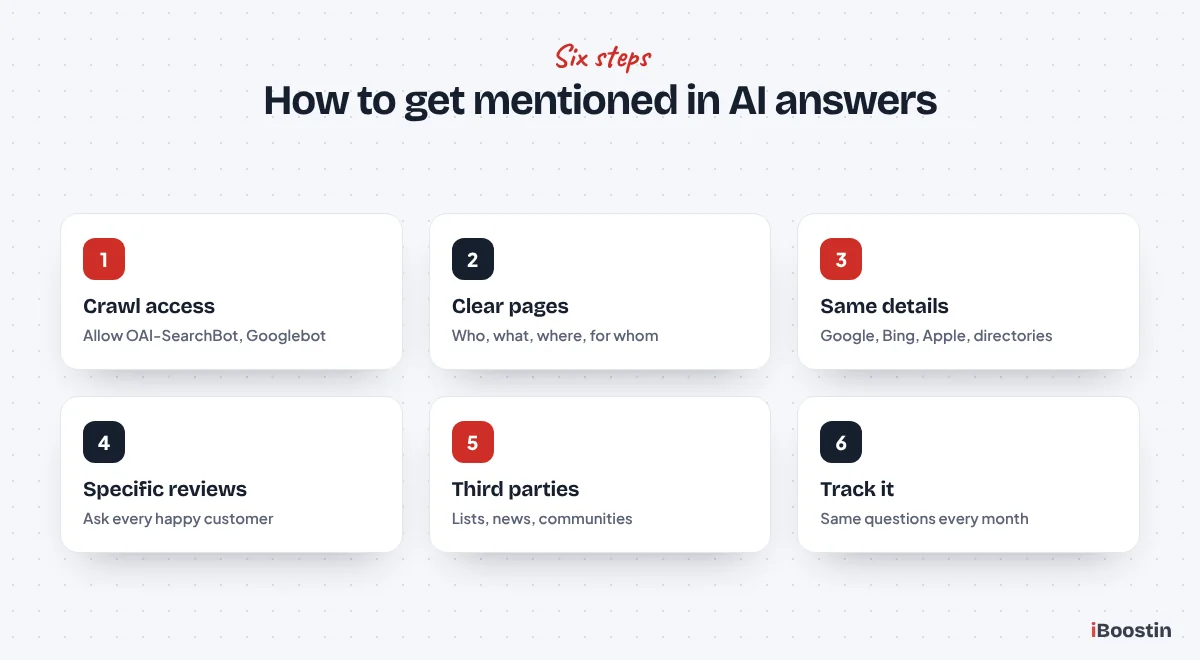
Open yourdomain.com/robots.txt and check which bots are allowed. OpenAI uses OAI-SearchBot for ChatGPT search and GPTBot for training its models. Google uses its normal Googlebot for AI Overviews and AI Mode. If your robots.txt or security settings block these crawlers, your pages may not be read for AI answers.
You can choose to block training crawlers while allowing search crawlers, if you prefer. What matters for being mentioned in ChatGPT search is that OAI-SearchBot can reach your pages. Some hosting firewalls and security plugins block unfamiliar bots by default, so check those settings too.
Make Key Information Easy to Read
Put your most important information in plain text on the page, not only inside images, sliders or downloadable files. Your services, areas served, contact details, opening hours and specialisms should be readable in the page text and ideally in structured data, such as Organization and LocalBusiness schema.
Pages that load content only after complex scripts run, or hide answers behind tabs and accordions, can be harder for some crawlers to read. Keep your core service information visible in the page’s main content. If you are unsure whether your site is readable, our guide on why a website is not showing up on Google covers the basic indexing checks.
What About llms.txt?
Some websites now publish an llms.txt file, a plain text summary of the site meant for AI tools. It is a proposal rather than a standard, and the major AI providers have not confirmed that they rely on it. It does no harm to have one, but it will not make up for weak pages, missing listings or a lack of reviews.
Spend your time on the steps that clearly matter first: crawl access, clear pages, consistent listings, reviews and mentions. If you add an llms.txt file, keep it accurate and in line with your main pages.
Step 2: Describe Your Business Clearly and Specifically
AI tools match businesses to questions. The more precisely your website describes what you do, for whom and where, the easier it is for an AI to match you to the right questions and explain why you fit.
Write a Clear “Who We Are” Statement
On your homepage and about page, state plainly who you are, what you do, who you serve and where. For example: “iBoostin is a remote SEO, WordPress and GoHighLevel agency for small businesses and agencies in the USA, UK and the Gulf.” One clear sentence like that is easier for an AI to reuse than a page of slogans.
Use the same description, in substance, across your website, Google Business Profile, social profiles and directory listings. Consistency is what turns your description into a recognized fact about your business.
Build Pages Around the Questions People Ask
People ask AI assistants detailed, conversational questions: “Which accountant in Leeds is good for restaurants?” or “Do I need a structural engineer for a loft conversion?” Use People Also Ask, Google autocomplete and your own enquiries to find these questions, then answer them clearly on your service pages and in articles.
Start each answer with one or two direct sentences, then add the detail. Include specifics that set you apart: industries you specialize in, certifications, areas covered, typical timelines. Our guide to keyword research for small business shows how to find these questions.
Use Comparison and “Best For” Content Carefully
Many AI questions are comparisons: “X vs Y”, “best option for a small budget”, “which is better for a new business”. Honest comparison content that explains who each option suits, including when you are not the right choice, gives AI tools useful material and builds trust with readers.
Avoid writing lists that rank your own business first without evidence. AI tools and readers both tend to discount obvious self-promotion. Fair, specific comparisons are more likely to be quoted and more likely to convert.
Step 3: Make Your Business Details Consistent Everywhere
AI tools cross-check information. If your business name, address, phone number, website and services are the same everywhere, the AI can be confident it is talking about the right business. If they differ, it may skip you or mix you up with someone else.
Claim the Main Business Listings
Claim and complete your Google Business Profile, Bing Places listing and Apple Business Connect listing, which feeds Apple Maps. ChatGPT’s search has been reported to draw partly on Bing results, so a complete Bing presence is worth the time. Add the main review and directory sites in your industry, such as Yelp, Tripadvisor for hospitality or Clutch for agencies.
Fill in every field: categories, services, areas, hours, photos and a clear description. Our guide on how to rank higher on Google Maps walks through the Google Business Profile settings in detail.
Fix Old and Conflicting Information
Search your business name and check what appears: old addresses, previous phone numbers, outdated service descriptions or duplicate listings. Fix or remove them wherever you can. Old directory entries that still show a former address can confuse both Google and AI tools.
Keep a simple record of where your business is listed and update all of them when anything changes. It is unglamorous work, but inconsistent details are one of the most common reasons we see a business described incorrectly, or not at all, in AI answers.
Step 4: Earn Reviews That Describe What You Do Well
Reviews are one of the strongest signals AI tools use when recommending local businesses. They show that real customers used you and what they valued. The content of the reviews matters as much as the star rating.
Ask Every Happy Customer
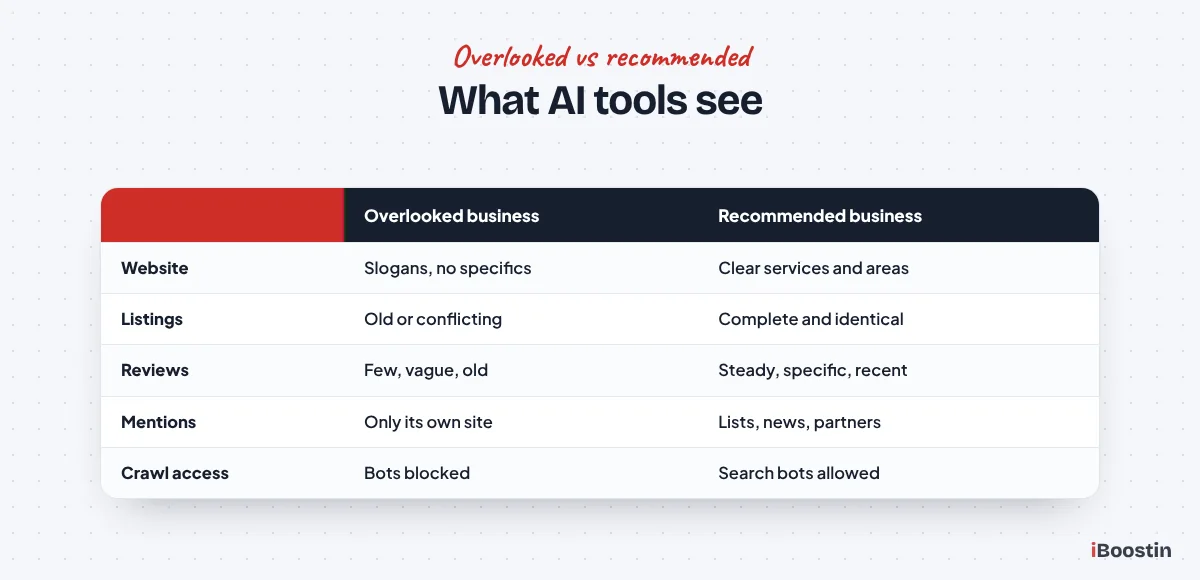
Build asking for reviews into your routine: a short message with your review link after every finished job. Ask on Google first, then on one or two platforms that matter in your industry. A steady flow of recent reviews is more convincing than a large number of old ones.
Never buy reviews, write fake ones or offer rewards for positive ones. It breaks the platforms’ rules, it can break consumer protection laws in many countries and it risks your listings. Genuine reviews are the only kind that build lasting trust.
Encourage Specific Reviews
A review that says “Great service” helps a little. A review that says “They fixed the leak in our 1930s house the same day and explained everything” helps much more, because it tells an AI what you do well and for whom. You can encourage this by asking customers to mention what they needed help with.
Reply to every review, mentioning the service where it fits naturally. Your replies add more context about what you offer, and they show both customers and AI tools that the business is active and cares about feedback.
Step 5: Get Mentioned on Trusted Third-Party Sites
This is the step that most often decides who gets recommended. AI tools give a lot of weight to what independent sources say about a business. A mention on a respected local site or an industry list can carry more weight than anything on your own website.
Get Into “Best of” Lists
Search for lists like “best web design agencies in Dubai”, “top accountants for startups in London” or “best plumbers in Austin”. Many AI answers draw on exactly these pages. Contact the authors of relevant lists, explain why your business fits and give them accurate details. Lists that are updated regularly are often open to new entries.
Industry review platforms and directories that rank businesses work the same way. A complete profile with genuine reviews on the platforms your buyers use puts your business into the sources AI tools read most.
Local News, Industry Sites and Expert Quotes
Local news coverage, industry publications and expert quotes in articles all count as independent mentions. Offer journalists useful comments in your area of expertise, share genuine stories about your business and contribute articles to publications your customers read.
These mentions double as backlinks, which also helps your Google rankings. Our guide on how to get backlinks for a new website lists the safest ways to earn them.
Genuine Community Discussions
Forums, community groups and discussion sites like Reddit appear often in AI answers, because they contain real opinions. Take part honestly where your customers gather: answer questions, share expertise and mention your business only when it genuinely helps.
Never post fake recommendations or use multiple accounts to praise yourself. Communities spot it quickly, moderators remove it and it damages your reputation. Real, helpful participation over time is what builds the kind of mentions AI tools trust.
Step 6: Track Whether AI Tools Mention You
AI answers change from one question to the next, so you cannot track them like a single Google ranking. Instead, track how often you appear across a fixed set of questions over time.
Ask the Same Questions Every Few Weeks
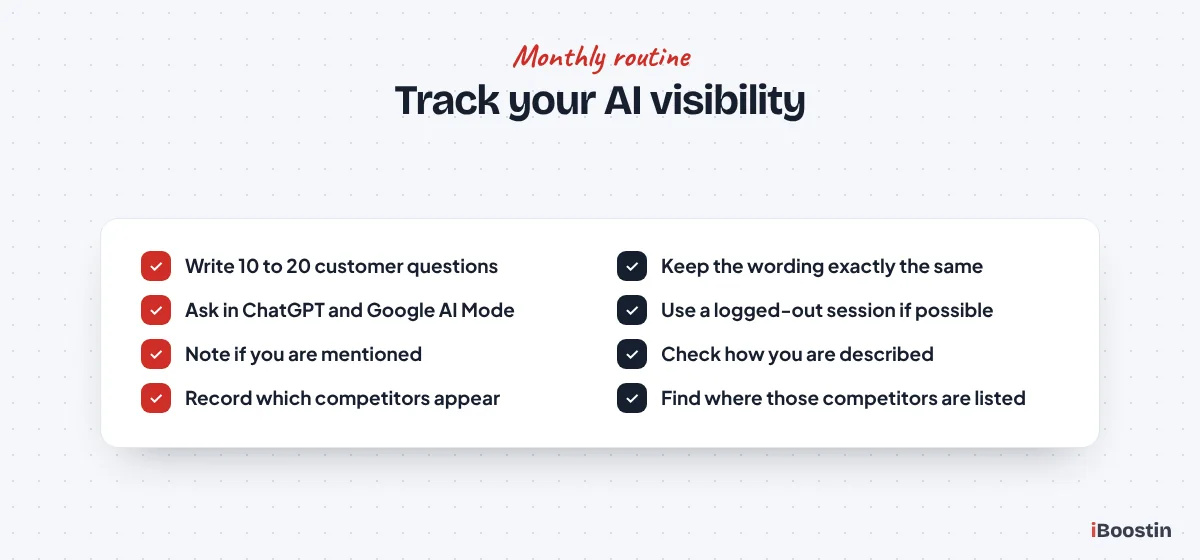
Write down ten to twenty questions your customers might ask, such as “best [your service] in [your city]” or “who can help with [problem] for a small business”. Every few weeks, ask them in ChatGPT, Google AI Mode and any other assistant your customers use, and note which businesses are mentioned and how yours is described.
Use a private or logged-out session where possible, and keep the wording exactly the same each time. You are looking for trends: are you mentioned more often, is the description accurate, which competitors keep appearing and why?
What to Do With What You Find
If you are not mentioned, look at the businesses that are. Which lists, review sites and articles mention them? Those are your targets. If you are mentioned but described wrongly, fix the source of the wrong information, usually an old listing or an unclear page on your own site.
There are also paid tools that track brand mentions across AI platforms at scale. They are useful for larger businesses and agencies, but a simple spreadsheet and a monthly routine is enough for most small businesses to see real progress.
What Matters Most for Different Types of Business
The steps above apply to everyone, but the sources AI tools lean on differ by industry. Putting extra effort where your customers’ questions are answered makes the work more efficient.
Local Service Businesses
For trades, clinics, salons and other local services, Google Business Profile, Bing Places, Apple Maps and review platforms carry the most weight. Questions like “best emergency electrician near me” are usually answered from listings and reviews, with local articles and directories as supporting evidence.
Focus on complete, identical listings, a steady flow of specific reviews, clear service area pages and mentions in local news or community sites. A local business that gets these right often appears in AI answers before larger competitors with weaker local signals.
Professional Services and B2B Firms
Accountants, consultants, agencies and B2B providers are often recommended for specific situations: “an accountant for e-commerce businesses” or “an SEO agency for dentists”. AI answers draw heavily on industry directories, review platforms like Clutch, expert articles and case studies.
Make your specialisms explicit on your website, publish detailed pages for each industry or situation you serve, and get listed and reviewed on the platforms your buyers use. Expert quotes and articles in industry publications are particularly valuable for these firms.
Common Mistakes That Keep Businesses Out of AI Answers
These are the issues we see most often when a business with good reviews and experience is still missing from AI recommendations.
Vague Websites and Inconsistent Details
A homepage full of slogans without a clear statement of what the business does, where and for whom gives AI tools nothing to work with. Combine that with different addresses and phone numbers across directories, and the AI has good reason to recommend someone it understands better.
Fix the basics first: a clear description, specific service pages, consistent listings everywhere. These changes are free and often make the biggest difference.
Trying to Game the Answers
Some businesses try to manipulate AI answers with fake reviews, planted forum posts, self-written “best of” lists that rank themselves first or pages stuffed with repeated phrases. These tactics are risky and tend to backfire. Platforms remove fake content, and AI tools increasingly weigh independent, consistent evidence over self-promotion.
The reliable route is slower but lasting: real reviews, real mentions and genuinely useful content. It builds the same trust with AI tools that it builds with customers.
Can You Pay to Be Mentioned in ChatGPT?
No. You cannot pay to be placed inside ChatGPT’s answers or Google’s AI Overviews. Some AI platforms have started testing clearly labeled ads shown alongside answers, but those are separate from the recommendations themselves. Being named in the answer depends on the information AI tools find and trust about your business.
What Investment Actually Helps
Money spent on the signals AI tools rely on does help: improving your website content, completing listings, building a review routine and earning coverage on respected sites. These are the same investments that improve your Google rankings, so the effort pays off in two places.
Be wary of any service that promises guaranteed placement in ChatGPT. Nobody controls those answers. A trustworthy provider will explain what they will improve, how they will measure it and that results vary by industry and location.
How Long It Takes
Changes to your website and listings can be picked up by AI search within weeks once they are crawled. Building the reviews and third-party mentions that lead to consistent recommendations usually takes several months, similar to building authority for Google. Our guide on how long SEO takes covers the broader timeline.
Expect gradual progress rather than a sudden switch. You may first appear for very specific questions, such as your exact specialty in your exact area, before you appear for broader ones. Each new review, listing fix and third-party mention adds to the picture AI tools have of your business, so steady monthly work matters more than one big push.
Getting Help With AI Search Visibility
Many of the steps in this guide are things a business owner can start today: checking robots.txt, rewriting the homepage description, claiming listings and asking for reviews. The harder parts are earning third-party mentions and keeping everything consistent over time.
What You Can Do Yourself
Start with your own website and listings. Write a clear description of your business, check that AI crawlers can reach your site, claim Google, Bing and Apple listings with identical details, and start a review routine. Then set up your list of tracking questions and check them monthly.
Our small business SEO checklist covers the website side of this in detail, and most items on it help both Google and AI visibility.
When to Work With Specialists
If competitors are consistently recommended instead of you, or your business is described inaccurately, specialist help can speed things up. Experience matters most in finding which sources AI tools rely on in your industry and earning mentions there.
Our generative engine optimization services and AI SEO services cover listings, content, mentions and monthly AI visibility tracking. For the complete picture, including Google rankings, see our SEO services.
Frequently Asked Questions About Getting Mentioned in ChatGPT
How do I get my business to show up on ChatGPT?
Make sure AI crawlers like OAI-SearchBot can reach your website, describe clearly what you do and where, and keep your business details identical across Google, Bing, Apple and industry directories. Collect genuine, specific reviews and earn mentions on trusted sites such as local news, industry publications and “best of” lists in your field.
Does ChatGPT recommend local businesses?
Yes. When people ask for local services, ChatGPT and Google AI Mode often name specific businesses, drawing on web search, business listings and reviews. Businesses with complete profiles, consistent details, strong recent reviews and mentions on local sites are the ones most likely to be recommended.
Does SEO help with ChatGPT visibility?
Yes. AI tools rely on many of the same signals as Google: clear, well structured pages, strong business profiles, reviews and links and mentions from trusted sites. Businesses that rank well on Google are more likely to appear in AI answers. GEO builds on SEO rather than replacing it.
Can I pay to get my business mentioned in ChatGPT?
No. You cannot pay to be included in ChatGPT’s answers. Some platforms are testing labeled ads shown separately from answers, but the recommendations themselves depend on the information AI tools find and trust. Be cautious of anyone who guarantees placement in AI answers.
How long does it take to appear in ChatGPT answers?
Website and listing improvements can be picked up within weeks once they are crawled. Consistent recommendations usually take several months, because they depend on reviews and third-party mentions building up over time. Track progress by asking the same questions every few weeks and noting how often you appear.
How do I check if ChatGPT mentions my business?
Write a list of questions customers might ask, like “best [service] in [city]”. Ask them every few weeks in ChatGPT, Google AI Mode and other assistants, using the same wording and a logged-out session where possible. Record whether you appear, how you are described and which competitors are named.
What is the difference between GEO and SEO?
SEO focuses on ranking your pages in search results. GEO, generative engine optimization, focuses on being cited or recommended inside AI-generated answers. They share most of their foundations: clear content, technical access, authority and reviews. GEO adds extra attention to entity consistency, third-party mentions and answer-ready content.
Make Your Business Easy to Recommend
AI tools recommend businesses they understand and trust. You make that easy by letting them read your site, describing your business clearly, keeping your details consistent, earning specific reviews and getting mentioned on the sites they rely on. None of it is a trick, and almost all of it improves your Google rankings at the same time.
Start with the steps you control this week: robots.txt, your homepage description and your listings. If you want to know exactly how AI tools describe your business today and what would change that, our team can run the check for you and build a plan around the gaps.