In this guide
- Is SEO Really Worth It for a Small Business?
- How to Check If SEO Is Worth It for Your Business
- Which Small Businesses Get the Most From SEO?
- How to Estimate What SEO Could Be Worth to You
- When SEO Is Not Worth It (Yet)
- Why SEO Fails for Some Small Businesses
- Is SEO Still Worth It With AI Search?
- Getting Started Without Wasting Money
- Frequently Asked Questions About Whether SEO Is Worth It
- The Short Answer for Your Business
SEO is worth it for most small businesses whose customers search online before they buy, as long as the owner can commit to it for at least six months. It brings steady leads that keep coming without paying for every click. It is not worth it for businesses with no search demand, no time to wait or no budget to do it properly.
That is the honest answer, and it is not the one you usually get. Agencies say yes because they sell SEO. Business owners on forums say no because they paid someone for six months and saw nothing. Both are describing real experiences. The difference is almost always whether SEO fitted the business in the first place and whether the work done was the right work.
This guide gives you a simple way to decide for your own business: how to check if people search for what you sell, how to estimate what ranking would be worth to you, when SEO is the wrong choice, and what separates SEO that pays back from SEO that wastes money. It comes from the decisions we help small business owners make every week at iBoostin. For the full step by step plan once you decide, see our guide to SEO for small business.
Key takeaways
- SEO is worth it when your customers search for your service, you can wait several months for results and you plan to be in business for years.
- You can estimate the value before spending anything: searches per month, your likely share of clicks, your enquiry rate and what one customer is worth.
- SEO is a poor fit for brand new ideas nobody searches for, very short campaigns and businesses that cannot handle more leads.
- Most “SEO did not work” stories come from targeting the wrong keywords, judging results too early or paying for low quality links.
- AI search has not made SEO pointless. ChatGPT and Google AI Mode rely on the same signals that help you rank.
Is SEO Really Worth It for a Small Business?
For most local and service businesses, yes. People search for plumbers, dentists, accountants, lawyers, cleaners, builders and agencies every day, and the businesses at the top of those results get most of the calls. SEO is how you get there without paying for each visitor. But “most” is not “all”, and the cases where it is not worth it matter just as much.
Why the Honest Answer Is Usually Yes
Search is where buying decisions start for anything people do not buy every week. When the boiler breaks, when a tooth hurts, when a business needs a new website, the first move is a Google search or, increasingly, a question to an AI assistant. Those people are not browsing. They have a problem and want someone to solve it, which makes search traffic some of the most valuable traffic a small business can get.
SEO also keeps working after the work is done. A service page that reaches the top of the results can keep bringing enquiries for months or years with only light upkeep. Compare that with paid ads, where every click costs money and the leads stop the day the budget runs out. In our client work, the businesses that commit to SEO for a year usually end up with a steady base of enquiries that no longer depends on how much they spend each month.
Why Some Owners Say It Was a Waste
The owners who say SEO was a waste usually had one of three experiences. They paid for a package that produced reports but no real improvements. They stopped after three months, right before the results would normally start to show. Or they were sold rankings for keywords nobody actually searches, so they “ranked” and still got no calls.
None of those mean SEO does not work. They mean the wrong work was done, or the right work was judged too early. That is why this guide spends as much time on how to tell good SEO from bad as on whether SEO is worth it at all. If you are weighing agencies, our guide on how to choose an SEO company lists the questions that filter out the packages that waste money.
How to Check If SEO Is Worth It for Your Business
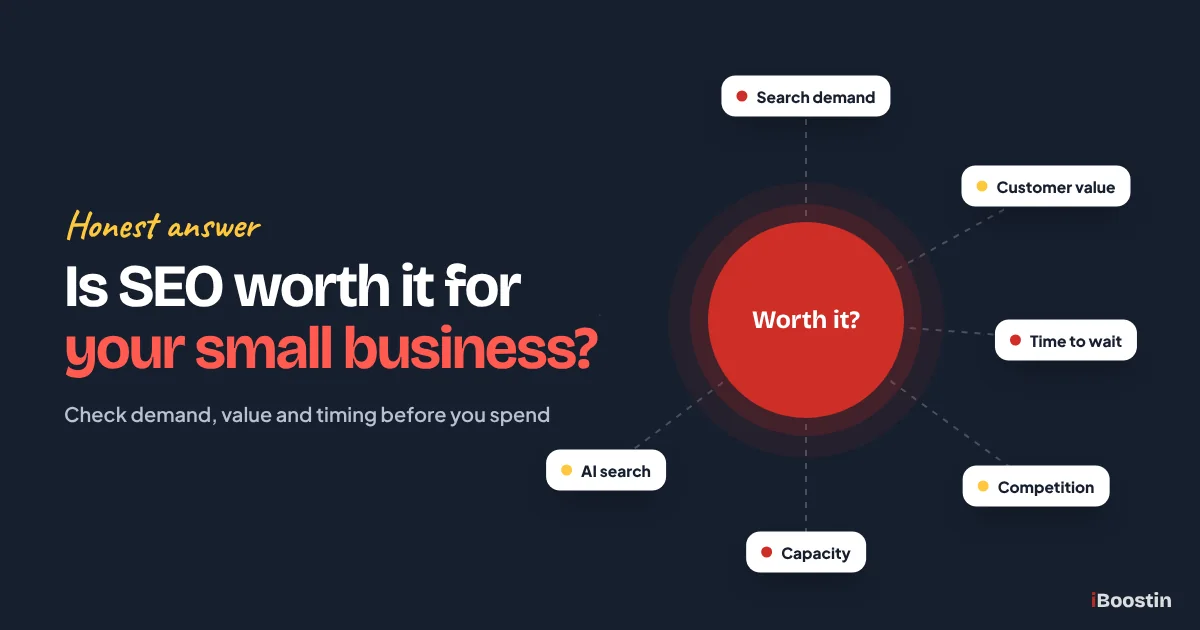
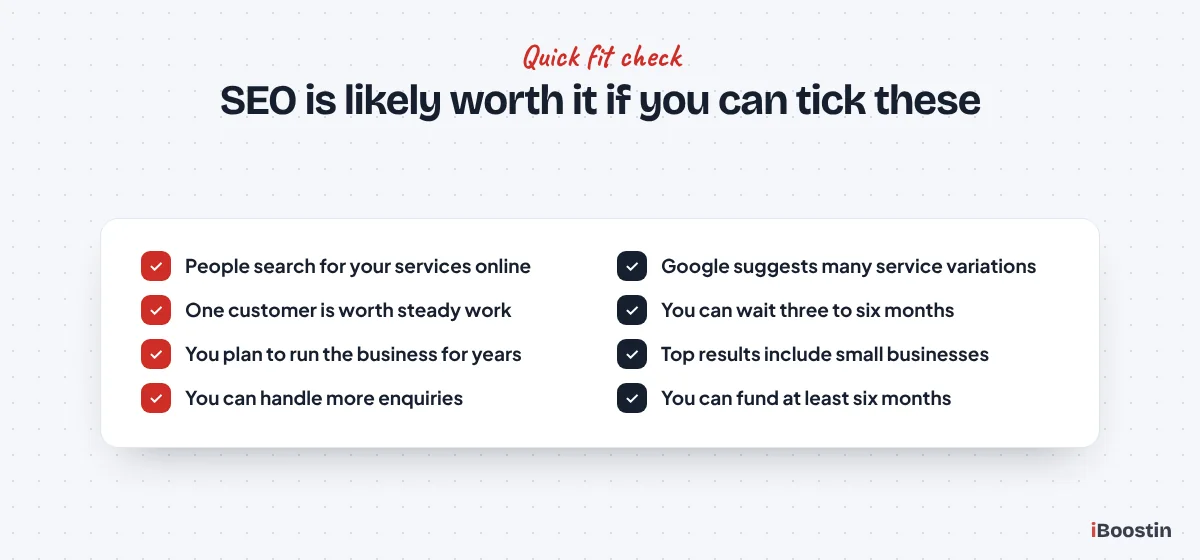
You do not have to guess. Four simple checks tell you whether SEO makes sense for your business before you spend anything. We run these same checks before we accept any new SEO client, because taking on a business where SEO cannot pay back helps nobody.
Do People Search for What You Sell?
SEO can only bring you customers who search. Type your main services into Google, with and without your town, and look at the autocomplete suggestions, the “People also ask” box and the related searches. If Google suggests many variations, there is demand. Free tools like Google Keyword Planner, or paid tools like Semrush and Ahrefs, show roughly how many searches each phrase gets per month.
Be realistic about what counts. A small number of searches can still be very valuable if each customer is worth a lot, like a kitchen remodel, a legal case or a monthly service contract. A large number of searches is not useful if they come from people who want free information rather than a business to hire. What you are looking for is searches from people who are ready to buy.
Is One New Customer Worth Enough?
The value of SEO depends on what a customer is worth to you over time, not only on the first sale. A dental clinic that gains a patient may keep them for years. An accountant who wins a client may work with them every month. A business that sells one low-margin item once needs far more traffic to make SEO pay back.
Work out what an average customer is worth to you over the time they stay, after your costs. Keep that number in mind for the estimate below. Businesses with high customer value almost always find SEO worth it, because even two or three extra customers a month cover a lot of work.
Can You Wait Several Months for Results?
SEO is slow to start. For most small business websites, the first clear improvements show up in three to six months, and strong positions for competitive searches usually take longer. A new domain takes more time than an established one. Our guide on how long SEO takes breaks down what to expect at each stage.
If you need leads this month to keep the business running, SEO alone is the wrong first step. Paid ads, referrals and direct outreach work faster. You can still start SEO alongside them, but you should not depend on it for income in the first few months. Owners who understand this upfront are the ones who stick with it long enough to see results.
How Strong Is the Competition?
Search your main service plus your area and look at the top five results. If they are mostly other small businesses, directories and thin pages, there is room for you. If they are national brands, big comparison sites and companies with years of content and links, page one will take much longer and cost more effort.
Strong competition does not mean SEO is not worth it. It means you should start with the smaller, more specific searches you can win, such as a sub-service or a nearby town, and build toward the big terms. Every niche has gaps. Finding them is exactly what good keyword research does.
Which Small Businesses Get the Most From SEO?
Some types of business get far more from SEO than others, because of how their customers search and how much each customer is worth. If your business is in one of the groups below, the case for SEO is usually strong.
Local Service Businesses
Plumbers, electricians, roofers, cleaners, dentists, clinics, salons, law firms and repair shops all serve customers who search with a location in mind. These businesses compete in the map results and the local organic results, where the competition is a handful of nearby companies rather than the whole internet. That makes page one far more reachable than in national markets.
They also tend to have urgent, high intent searches. Someone searching for an emergency electrician or a dentist open today is ready to call the first trustworthy result. For these businesses, a complete Google Business Profile, strong service pages and steady reviews often bring the first new calls within a few months, which is why local services are usually the clearest yes.
Professional Services and B2B Firms
Accountants, consultants, agencies, software providers, manufacturers and other business to business companies often have fewer searches but much higher customer value. A single new client may be worth a year of work. Their buyers also research carefully, reading several pages before they make contact, which rewards detailed, helpful content.
For these firms, SEO works best when service pages are paired with articles that answer the questions buyers ask before they hire: costs and what affects them, how the process works, how to compare providers. Each article that ranks puts the firm in front of buyers early in their research, often long before a competitor is even considered.
Online Stores With Searchable Products
Ecommerce stores benefit from SEO when people search for the products they sell, by name, type or problem. Category pages and product pages that rank bring buyers without paying for every click, which matters in markets where paid shopping ads are expensive.
The challenge for small stores is competing with marketplaces and big retailers. The gaps are usually in specific product types, niche categories and buying guides that big sites cover thinly. A focused store that becomes the best answer for a narrow set of products often does better in search than a broad store that tries to rank for everything.
How to Estimate What SEO Could Be Worth to You
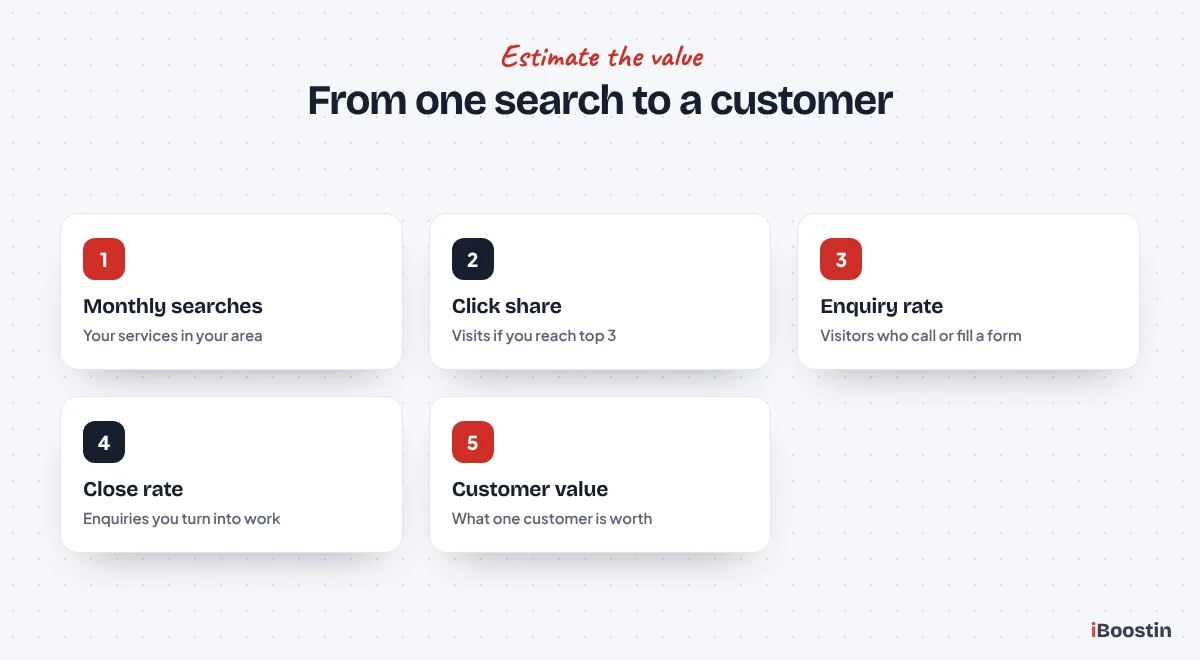
You can put a rough number on SEO before you commit. It will not be exact, but it turns a vague decision into a simple one. The idea is to follow one search from the person typing it to the money in your account.
A Simple Way to Run the Numbers
Start with how many people search for your main services each month in your area. Then estimate the share of those searches that would click on your result if you were near the top of page one. Of those visitors, estimate how many would call or fill in a form, and of those, how many would become customers. Multiply the customers by what a customer is worth to you.
Here is an illustration with round numbers, not a promise. Suppose 600 people a month search for your services in your area. If you reached the top three, perhaps 10 to 20 percent of them might click on your site, so 60 to 120 visits. If 5 percent of visitors enquire, that is 3 to 6 enquiries. If you win half of them, that is 2 or 3 new customers every month. Now multiply that by what one customer is worth to you over time.
What the Estimate Leaves Out
That simple calculation usually underestimates the value. It counts only your main keywords, but a well built site also ranks for dozens of smaller searches that add up. It ignores the people who see your name, remember it and search for you directly later. And it ignores referrals from customers who found you through search in the first place.
It also ignores the cost side, which you need to weigh honestly. SEO costs either your own time or an agency or freelancer fee every month, and results start slowly. Compare the estimated monthly value after six to twelve months with what you would spend over the same period. If the value clearly exceeds the cost once rankings arrive, SEO is worth it for you.
Pro tip: check the Queries report in Google Search Console if your site is already live. It shows real searches where you already appear, with impressions, so you can see actual demand rather than relying only on tool estimates.
When SEO Is Not Worth It (Yet)
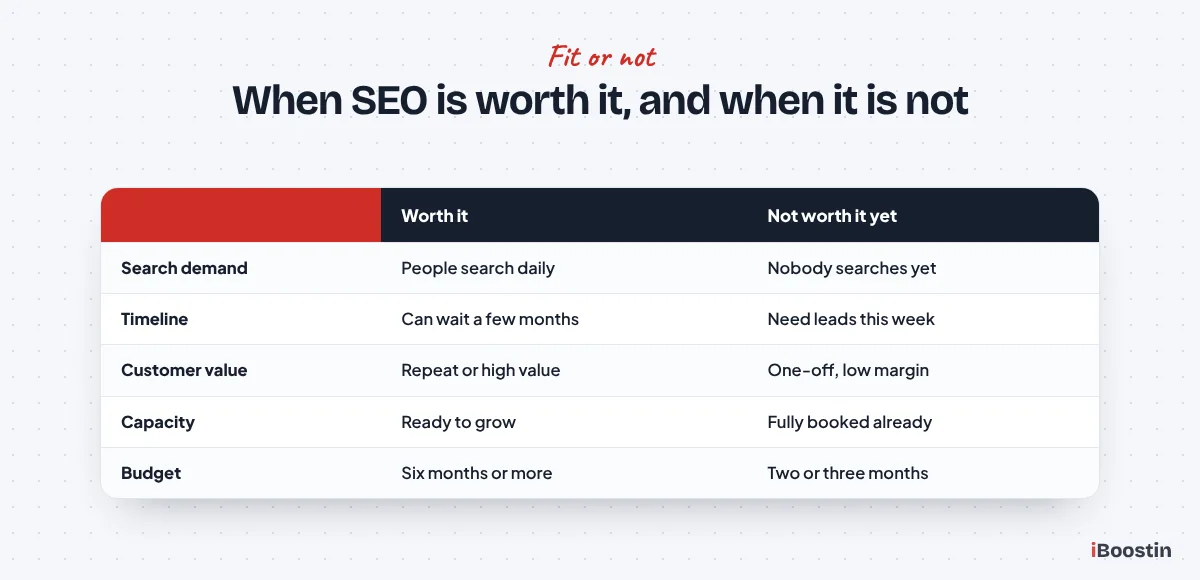
There are real situations where SEO is the wrong choice, or the wrong first choice. Saying so plainly saves money and frustration. In each case below, something else usually works better first, and SEO can follow later.
Nobody Searches for What You Sell Yet
If you have invented a new product or service that people do not know exists, they cannot search for it. SEO can only capture demand that already exists. In that case, social media, paid social ads, partnerships, PR and direct sales are better ways to create awareness first.
There is often a related search you can still target. People may not search for your new product by name, but they search for the problem it solves. Writing about that problem can work, but it is a slower, indirect route, and you should treat it as a long-term investment rather than a source of immediate leads.
You Need Leads Within Weeks
A brand new business with bills to pay, a seasonal offer that ends next month, or a launch with a fixed deadline needs faster channels. Paid search ads can put you at the top of Google today. Local service ads, directories and outreach can bring calls this week. SEO will not.
The smart approach is often to run paid ads for immediate leads while SEO builds underneath, then shift budget toward SEO as organic traffic grows. We compare both options in detail in SEO vs PPC for small business. For many owners, the answer is not one or the other but the right mix at the right time.
You Cannot Handle More Work
It sounds strange, but some businesses are already fully booked. A one-person trade with a three-month waiting list does not need more enquiries right now. SEO would bring leads they cannot serve, and the money would be better spent on hiring, systems or raising prices.
SEO makes sense again when the business is ready to grow: a new hire, a new location or a new service line. Planning SEO around that moment, rather than starting it when you are already overloaded, gets far better value from the same work.
Your Budget Only Covers a Few Months
SEO done for two or three months and then stopped is the most common way to waste money on it. The early months mostly go into fixing foundations, building pages and starting authority. Results usually arrive after that. Stopping early means paying for the setup without collecting the return.
If your budget is limited, do less but keep going. Focus on the highest value pieces, such as your Google Business Profile, one strong page per main service and steady reviews, and keep them going for a year. That approach beats a big burst of activity that stops before it pays off.
Why SEO Fails for Some Small Businesses
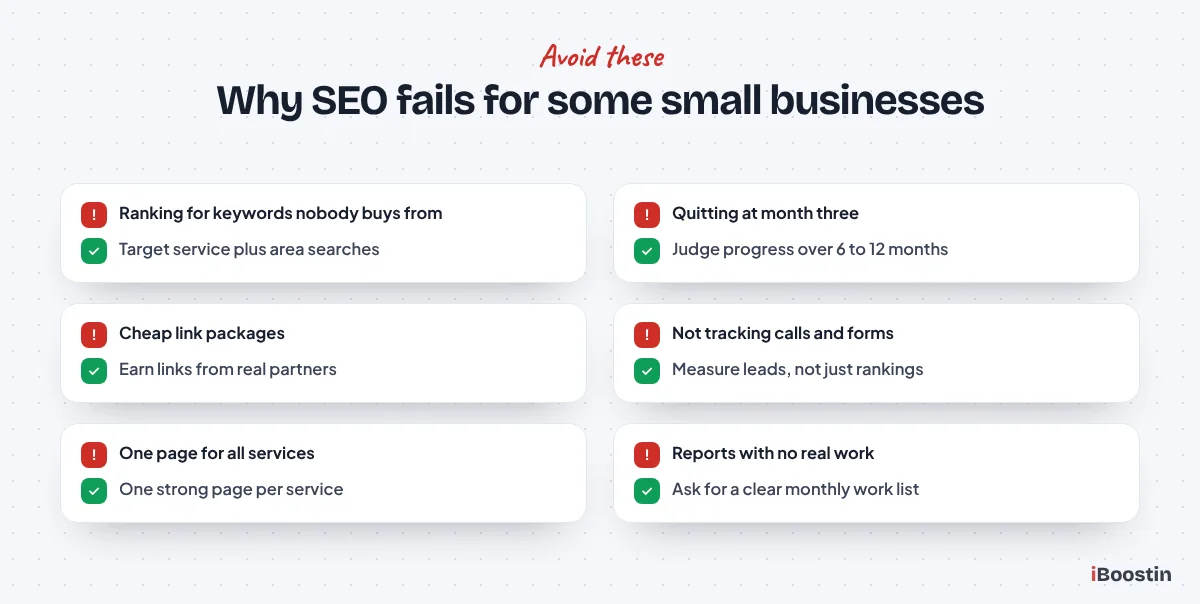
When SEO does not pay back, the cause is usually something that could have been avoided. Knowing these failure points helps you judge any SEO work, whether you do it yourself or hire someone.
Ranking for Keywords That Do Not Bring Buyers
Some SEO campaigns report great rankings for phrases nobody searches or phrases that bring the wrong visitors, like students researching a topic rather than customers looking to hire. The report looks good, but the phone does not ring. This is the most common reason owners feel SEO is a scam.
Always ask which searches a page is meant to win and whether people typing those searches are ready to buy. Service plus location, specific sub-services and problem searches from customers are the targets that bring leads. Broad educational terms can help build authority, but they should support the money pages, not replace them.
Judging Results Too Early
Owners often expect page one within a month and give up at month three. Google needs time to crawl new pages, test them for different searches and build trust in a newer site. Impressions usually rise first, then positions, then clicks. Stopping before the clicks arrive means you paid for the hardest part and walked away from the reward.
Agree on what progress should look like at each stage before you start: indexing fixed in the first weeks, impressions growing in months two and three, positions improving after that. If those early signals appear, the work is on track even if leads have not arrived yet.
Cheap Links and Shortcuts
Bulk link packages, private blog networks and fake reviews promise quick results. They might move a ranking briefly, but Google is very good at ignoring or penalizing them. Recovering from a penalty takes far longer than doing SEO properly would have, and some businesses never fully recover their rankings.
Real authority comes from real relationships: suppliers, associations, local organizations, partners, genuine press mentions and useful content people want to reference. It is slower, but nothing you build has to be undone later. Our guide on how to get backlinks for a new website lists the safe sources.
Nobody Measuring What Matters
Many small businesses never connect SEO to actual enquiries. They look at a ranking report once a month and have no idea how many calls or forms came from search. Without that, it is impossible to tell whether SEO is worth it, and easy to cancel work that was actually paying back.
Set up Google Search Console and analytics, track calls and form submissions, and ask new customers how they found you. Even a simple tally in a spreadsheet tells you more than a ranking report. When you can see leads from search growing month by month, the question of whether SEO is worth it answers itself.
Is SEO Still Worth It With AI Search?
Autocomplete shows people asking whether SEO is worth it “anymore”, mostly because of AI tools. The short answer is yes. ChatGPT, Google AI Overviews and AI Mode do not replace the need to be found online. They change where and how you are found.
AI Tools Lean on the Same Signals
AI assistants build answers from web pages they can read and from what trusted sources say about businesses. When someone asks for a good accountant for small restaurants in their city, the businesses that get mentioned are the ones with clear websites, strong reviews and mentions on directories, lists and local sites. That is exactly what good SEO builds.
So the work is not wasted. A clear service page, a complete Google Business Profile, honest reviews and links from respected sites help you rank on Google and help AI tools understand and recommend you. We explain the extra steps in how to get your business mentioned in ChatGPT.
What Changes for Small Businesses
Some simple informational searches now get answered directly at the top of Google, so fewer people click through for basic questions. That matters most for websites that earn money from information alone. For a local or service business, the searches that matter, like hiring someone or booking an appointment, still lead to a click, a call or a visit.
What changes is the bar for content. Pages need to answer questions clearly and specifically, show real experience and make your business easy to describe. Generic articles written only to rank are worth less than before. Useful, specific pages tied to your services are worth more.
Getting Started Without Wasting Money
If the checks above say SEO is worth it for your business, the way you start decides whether it pays back. Start with the work that has the highest return and keep it going.
The First Things Worth Doing
Set up Google Search Console and fix anything that stops your pages from being indexed. Complete your Google Business Profile and start asking every happy customer for a review. Make sure each main service has its own clear page that answers customer questions. These steps cost little, bring the fastest results and make every later step work better.
Then build from there: keyword research to find the searches you can win, on-page improvements to your key pages, and steady authority building through real links and mentions. Our SEO for small business guide lays out each step in the order that pays off fastest.
When to Bring in Help
If you have the time and your market is not very competitive, you can do the early steps yourself. If your competitors are already investing in SEO, if you have technical problems you cannot solve or if your time is better spent running the business, working with a specialist usually pays for itself through faster progress and fewer mistakes.
Look for someone who checks whether SEO fits your business before selling it, explains their plan in plain language and reports on enquiries, not just rankings. That is how we work at iBoostin: our SEO services start with an honest opportunity check, and we tell you if SEO is not the right move yet.
Frequently Asked Questions About Whether SEO Is Worth It
Is SEO worth it for a small local business?
Usually yes. Local businesses often see results faster than national ones, because they compete with fewer businesses and benefit from Google Maps results. A complete Google Business Profile, strong service pages and steady reviews can bring calls within a few months. It is worth it as long as people search for your services in your area.
Is SEO worth the money compared with paid ads?
Paid ads bring leads faster but stop when you stop paying. SEO is slower to start but keeps bringing leads without paying for each click once rankings are built. For businesses planning to operate for years, SEO usually costs less per lead over time. Many small businesses run ads first and build SEO alongside them.
How long before SEO is worth it?
Most small businesses see early signs, like rising impressions in Search Console, within the first two or three months, and meaningful leads after three to six months. Competitive industries and brand new websites take longer. Judge SEO on its progress over six to twelve months rather than on the first few weeks.
Is SEO worth it in 2026 with AI search?
Yes. AI tools like ChatGPT and Google AI Mode build their answers from websites, reviews and mentions they can find. The businesses they recommend are usually the ones with clear pages, strong reviews and mentions on trusted sites, which is what SEO builds. What has lost value is generic content written only to rank.
Can a small business do SEO itself instead of paying for it?
Yes, for the basics. Owners can set up Search Console, complete their Google Business Profile, ask for reviews and write clear service pages. Technical fixes, competitive keyword strategy and link building usually need more experience. DIY works best in less competitive markets where the owner can give it a few hours every week.
What happens if I stop doing SEO?
Rankings rarely disappear overnight. Pages that rank well usually hold their positions for a while, then slowly slip as competitors keep improving and your content ages. Basic upkeep, like fresh reviews, updated pages and occasional new links, keeps most of the value. Stopping completely in a competitive market usually means losing ground over the following months.
How do I know if SEO is working for my business?
Check Google Search Console monthly for rising impressions, better average positions and more clicks. Then check real outcomes: calls, forms and bookings from organic search and your Google Business Profile. Ask new customers how they found you. If leads from search grow over six to twelve months, SEO is working.
The Short Answer for Your Business
SEO is worth it for a small business when people search for what you sell, a customer is worth enough to justify steady work, and you can give it six to twelve months. It is not worth it when nobody searches for your offer yet, when you need leads within weeks or when you can only fund a couple of months. Most local and service businesses fall clearly into the first group.
If you are not sure which group you are in, the checks in this guide will tell you, or we can run them with you. We look at real search demand for your services, the strength of the businesses ranking today and what page one would realistically take, then give you a straight answer.