In this guide
- What Is the Difference Between SEO and PPC?
- SEO vs PPC: Side by Side
- Pros and Cons for a Small Business
- Which Should You Invest in First?
- SEO vs PPC for Local Businesses
- How SEO and PPC Work Better Together
- How Each Channel Fits With AI Search
- A 12 Month Plan From Paid to Organic
- Getting Help With SEO, PPC or Both
- Frequently Asked Questions About SEO vs PPC
- The Right Mix Beats the Right Channel
For most small businesses, the best answer to SEO vs PPC is both, in the right order: PPC (pay-per-click ads like Google Ads) for leads this month, SEO for leads that keep coming without paying for every click. If you can only pick one, choose PPC when you need results fast and SEO when you can wait three to six months.
Most owners arrive at this question after a bad experience with one of them. They ran Google Ads, spent a lot and got clicks that never called. Or they paid for SEO for a few months and saw nothing. Then someone tells them the other channel is the real answer. Usually neither channel was the problem. The problem was using the wrong one for the stage the business was in, or measuring it the wrong way.
This guide compares SEO and PPC on what actually matters to a small business: speed, cost per lead over time, control, trust and how each one works for local searches and AI search. Then it gives you a simple decision by business situation and a plan for moving from paid to organic over a year. It is how we advise clients at iBoostin, where we run both. For the full SEO plan, see our guide to SEO for small business.
Key takeaways
- PPC brings leads within days but stops the moment the budget stops. SEO takes months to start but keeps bringing leads without paying per click.
- Over a year or more, SEO usually costs less per lead. In the first months, PPC almost always wins on speed.
- Local businesses should look at three spots: ads, the Google Maps results and organic results. The map pack is earned through your Business Profile, not bought.
- PPC data tells you which keywords bring paying customers, which makes your SEO sharper and less risky.
- A good plan for most small businesses: start with focused ads and SEO foundations together, then shift budget toward SEO as organic leads grow.
What Is the Difference Between SEO and PPC?
SEO and PPC both aim to put your business in front of people searching on Google, but they get there in opposite ways. With PPC you pay for each click and appear instantly. With SEO you earn your position over time and pay nothing per click. Everything else, from cost to trust to speed, follows from that difference.
How SEO Works
SEO, or search engine optimization, is the work of making your website and Google Business Profile the best answer for the searches your customers make. It covers technical setup, service pages, content, reviews and links from other websites. When Google trusts your pages, it shows them in the organic results and the map pack, and every click is free.
The catch is time. Google needs to crawl your pages, test them and build trust in your site before it ranks you near the top. For most small business sites, clear results take three to six months, and competitive searches take longer. Our guide on how long SEO takes breaks down what happens month by month.
How PPC Works
PPC, or pay-per-click advertising, means paying to appear in the sponsored results at the top and bottom of search pages. The most common platform is Google Ads, with Microsoft Ads as a smaller option. You choose the keywords, write the ads, set a budget and bid against other advertisers. Your ad can appear the same day your campaign is approved.
You pay each time someone clicks, and the price depends on how many other businesses want the same keyword. In competitive industries like legal, home services and finance, clicks can be expensive. The moment you pause the campaign or the budget runs out, your ads disappear and so do the leads.
Where Each One Appears on the Results Page
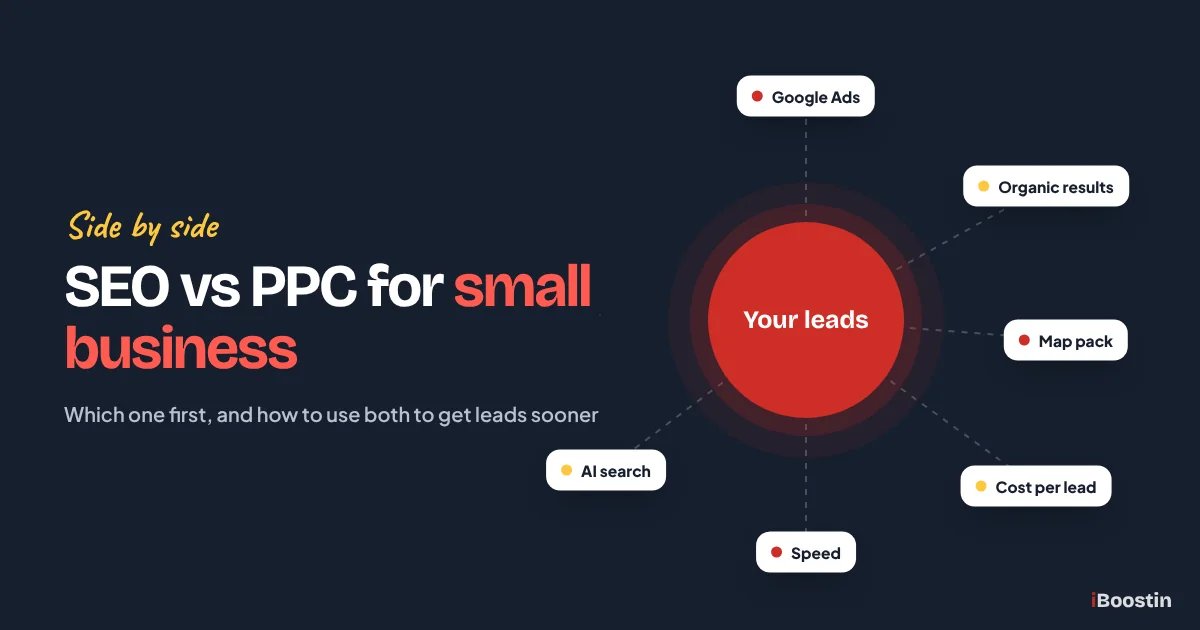
On a typical local search, Google shows sponsored ads first, then often a map with three local businesses, then the organic results. Some searches also show an AI Overview near the top. Each of these spots is reached differently, and a small business can appear in more than one at the same time.
| Spot on the page | How you get there | Pay per click? |
|---|---|---|
| Sponsored ads (top and bottom) | Google Ads campaigns | Yes |
| Local Services Ads (some industries and countries) | Google Local Services Ads, pay per lead | Pay per lead |
| Map pack (three local businesses) | Google Business Profile, reviews, local SEO | No |
| Organic results | SEO: pages, content, links, technical health | No |
| AI Overviews and AI Mode | Clear content, authority and mentions | No |
This layout is why the question is rarely SEO or PPC for a local business. Ads cover the top of the page, your Business Profile covers the map, and SEO covers the organic list and much of what AI answers draw from. A business that shows up in two or three of these spots for the same search looks like the obvious choice, and usually gets the call.
SEO vs PPC: Side by Side
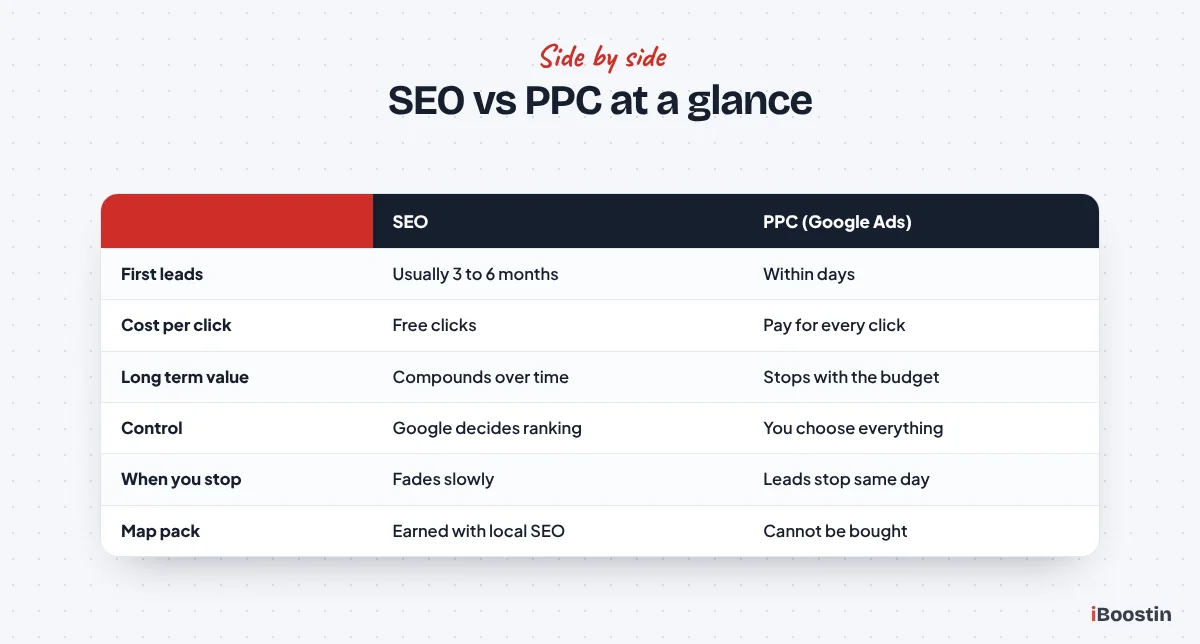
Comparing the two channels on the same points makes the choice much clearer. Neither is better at everything. Each one wins on different things, which is exactly why they work well together.
Speed to First Leads
PPC wins on speed, clearly. A well built Google Ads campaign can bring calls within days of launch. SEO cannot match that, especially on a newer website. If you need enquiries this month to keep the business running, PPC is the only one of the two that can deliver them.
SEO does have some fast wins. Fixing indexing problems, completing a neglected Google Business Profile or improving pages already sitting on page two can bring results within weeks. But for new rankings on competitive searches, plan for months, not days.
Cost per Lead Over Time
In the first months, PPC usually costs less per lead, because SEO is still building and bringing few leads yet. Over a year or longer, the picture often flips. SEO costs stay roughly flat while organic leads keep growing, so the cost of each lead falls. With PPC, every lead costs roughly the same click price forever, and those prices tend to rise as more competitors bid.
That is why we look at SEO and PPC on a twelve to twenty four month view, not month by month. A business that only compares the first three months will always choose ads. A business that compares two years usually ends up investing more in SEO and using ads for specific goals.
What Happens When You Stop
When you stop paying for PPC, your ads disappear the same day and the leads stop with them. There is no lasting asset. Everything you learned is valuable, but the visibility itself is rented.
When you stop SEO work, your rankings do not vanish overnight. Pages that rank well usually hold their positions for a while and then slowly slip as competitors improve. The pages, reviews and links you built stay yours. That lasting value is the main reason SEO is called an investment rather than an expense.
Control and Testing
PPC gives you precise control. You choose exactly which searches trigger your ads, which areas and times they show, what the ad says and which page people land on. You can test a new offer or headline and see results within days. That makes PPC excellent for testing.
SEO gives you less direct control. You can make your page the best answer, but Google decides where it ranks and which text it shows. Changes take weeks to show their effect. SEO rewards patience and quality, while PPC rewards fast testing and budget management.
Trust and Click Behavior
Many searchers skip the sponsored results and click the first organic listing or a business in the map pack, because they see those positions as earned rather than bought. Others click ads without a second thought, especially for urgent needs. Both behaviors exist, and they vary by industry and by how urgent the search is.
What is consistent is that appearing in several places at once builds confidence. When a customer sees your ad, then your map listing with good reviews, then your organic result, you look like the established choice. That is one of the strongest arguments for running both.
Pros and Cons for a Small Business
Here is the short version of each channel’s strengths and weaknesses for a business with limited time and budget.
SEO: Pros and Cons
The main advantages of SEO are that clicks are free, results compound over time and rankings build trust and authority that ads cannot buy. It also feeds AI search: the businesses that rank well and are widely mentioned are the ones AI tools tend to recommend. For local businesses, SEO and a strong Business Profile are the only way into the map pack.
The disadvantages are time and uncertainty. Results take months, Google’s updates can move rankings, and competitive industries need sustained work on content and authority. SEO also needs either your own time every month or a specialist, and it is hard to switch on or off quickly for a short promotion.
PPC: Pros and Cons
The main advantages of PPC are speed, control and data. You can appear tomorrow, target exactly the searches and areas you want, test offers quickly and see which keywords bring paying customers. It is ideal for launches, seasonal offers and new services.
The disadvantages are ongoing cost and dependency. Every click costs money, competitive clicks can be expensive, and leads stop when the budget stops. Badly managed campaigns waste money fast on irrelevant searches, so PPC needs careful setup, negative keywords and conversion tracking to pay off.
Which Should You Invest in First?
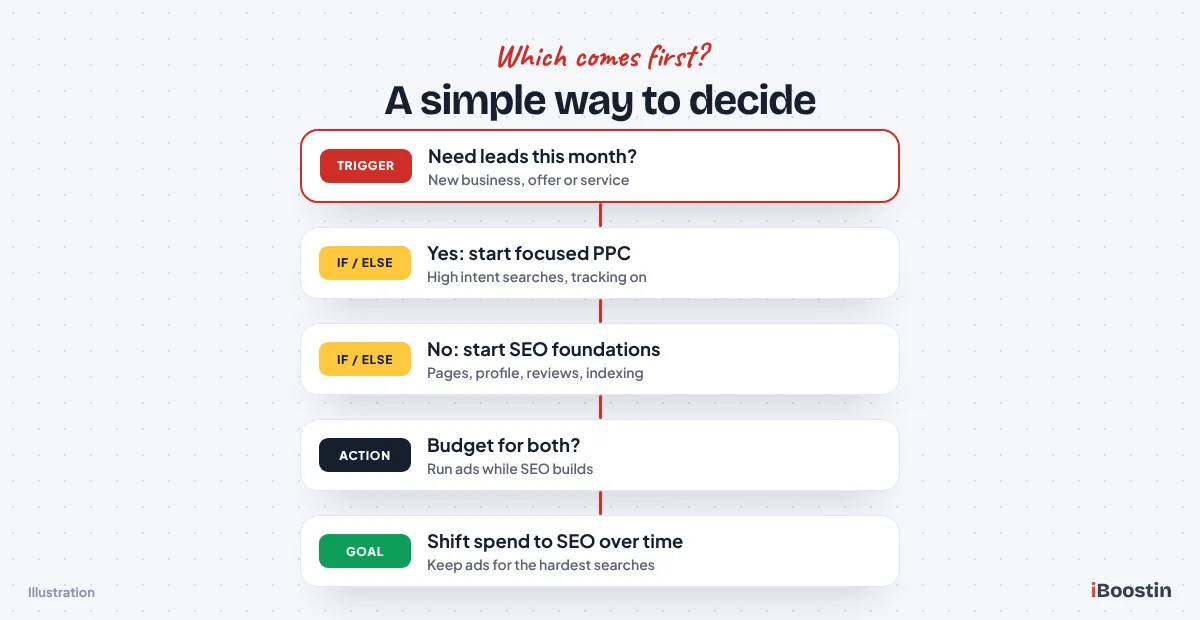
Autocomplete shows owners asking which one to invest in first. The answer depends on your situation more than on the channels themselves. Find the description closest to your business below.
Choose PPC First If You Need Leads Now
If your business is new, has no reviews or organic visibility yet and needs enquiries to pay the bills, start with PPC. The same applies to seasonal businesses, time-limited offers and new services you want to test before investing heavily. A tightly focused campaign on high intent searches can bring leads while you build everything else.
Start small and focused rather than broad. Target the searches closest to a purchase, like your service plus your area, set up conversion tracking from day one and send traffic to a page built for that service. Our Google Ads management service is set up exactly this way for small businesses.
Choose SEO First If You Can Wait
If you have steady work from referrals or existing customers and want to build a lasting source of leads, start with SEO. The same applies if clicks in your industry are expensive, because every lead from organic search saves you that cost. Businesses planning to operate for many years get the most from starting SEO early.
Begin with the foundations: Search Console, indexing, a complete Google Business Profile, one strong page per service and a review routine. These steps bring the fastest SEO results. If you are unsure whether SEO fits your business at all, our guide on whether SEO is worth it for small business walks you through the checks.
Choose Both If You Can Fund Them
If your budget allows it, running both from the start is usually the strongest option. PPC brings leads in the first months while SEO builds underneath. As organic visibility grows, you reduce ad spend on the searches where you now rank well and keep ads for competitive or high value searches.
The key is to fund both properly rather than splitting a small budget so thin that neither works. A focused ad campaign on a handful of high intent searches plus steady SEO on your core pages beats a scattered campaign and a half-done website.
SEO vs PPC for Local Businesses
For local businesses, the comparison has an extra dimension: the map pack. On searches like “plumber near me” or “dentist in Austin”, the three businesses shown on the map often get a large share of the calls. You cannot buy your way into the map pack with standard ads. It is earned through local SEO.
The Map Pack Is Earned, Not Bought
Google ranks map results mainly on relevance, distance and prominence. A complete Google Business Profile with the right category, accurate services, real photos, steady reviews and consistent business details across directories is what moves you up. Some ad formats can appear near the map, but the three organic map spots themselves cannot be bought.
That is why local SEO is often the best value channel for trades, clinics and local services. A business that ranks in the map pack for its main service in its area gets a steady stream of calls without paying per click. Our guide on how to rank higher on Google Maps explains each step.
Local Services Ads as a Middle Option
In some countries and service categories, Google offers Local Services Ads, which appear at the very top for searches like “electrician near me”. They are paid, but you pay per lead rather than per click, and they show a verification badge after Google screens the business. For eligible trades, they can be a useful bridge while organic and map rankings build.
Check whether your industry and area are eligible, and treat them like any paid channel: track every lead, dispute invalid ones and compare the cost per customer with your other channels. They complement local SEO rather than replacing it, because the same reviews and profile strength help both.
How SEO and PPC Work Better Together
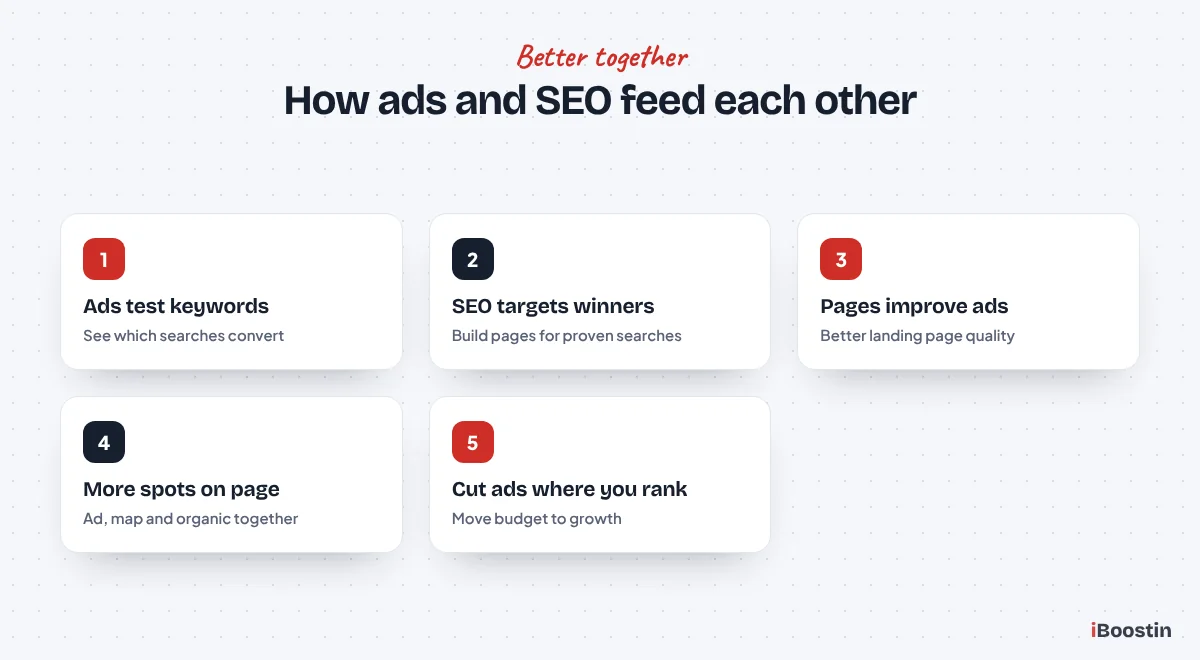
The strongest small business setups we see use each channel to make the other better. Running them together is not just about covering more of the page. The data and the brand effect flow both ways.
Use PPC Data to Choose SEO Keywords
SEO is slow, so choosing the wrong keywords costs months. PPC removes much of that guesswork. Within a few weeks of running ads, you can see which searches bring calls and paying customers, and which bring clicks that never convert. That is real buying data, not estimates from a tool.
Take the searches that convert best in your ads and make them the priority for your SEO pages. You are then building organic rankings for searches you already know bring customers. It is one of the most practical reasons to run a small ad campaign even if SEO is your long-term focus.
Use SEO Pages to Make Ads Cheaper
Google rewards ads that send people to relevant, useful pages with better ad quality, which can lower what you pay per click. The same well written service pages you build for SEO make strong landing pages for ads. One investment improves both channels.
Pages that answer customer questions clearly also convert more of the visitors you pay for. A detailed service page with reviews, process, pricing factors and FAQs turns more ad clicks into enquiries than a thin page with a contact form, which lowers your real cost per lead.
Reduce Ad Spend Where You Rank Well
As your organic rankings improve, look at the searches where you now appear in the top three organic results or the map pack. For some of them, you can reduce or pause ad spend and keep most of the leads through organic results. Test this carefully, one search at a time, and watch total leads rather than just ad clicks.
Keep ads running on searches that are very competitive, very valuable or where you do not rank yet. Over time, the ad budget concentrates on the searches where it adds the most, while SEO carries an increasing share of the leads.
How Each Channel Fits With AI Search
AI Overviews, AI Mode and ChatGPT are changing how people find businesses, and they affect SEO and PPC differently. This is a fast-moving area, so treat the details as current practice rather than permanent rules.
What AI Search Means for SEO
AI answers draw on pages that rank well and on what trusted sources say about businesses. The work that builds SEO, clear service pages, a complete Business Profile, honest reviews and mentions on respected sites, is the same work that gets a business mentioned in AI answers. That makes SEO more valuable, because it now feeds two kinds of visibility.
Simple informational searches may send fewer clicks when AI answers them directly. For service businesses, the searches that matter, such as hiring someone or booking an appointment, still lead to calls and visits. We cover the extra steps in how to get your business mentioned in ChatGPT.
What AI Search Means for PPC
Google continues to show ads alongside AI features, and ad formats keep evolving as AI results grow. The fundamentals of PPC, targeting high intent searches, tracking conversions and sending people to strong landing pages, have not changed. What changes is that more of the page is taken by AI answers on some searches.
For small businesses, that is another reason not to rely on a single channel. A mix of map pack presence, organic rankings, AI visibility and focused ads spreads the risk if any one part of the results page changes.
A 12 Month Plan From Paid to Organic
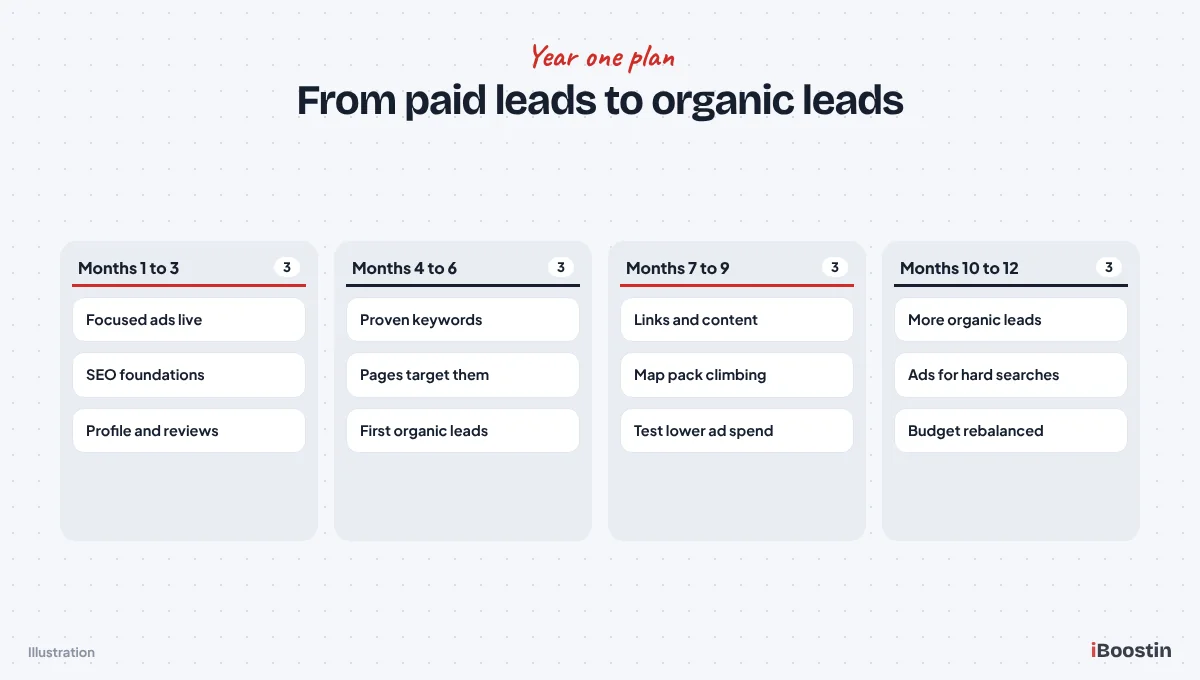
If you decide to run both, this is the shape of the plan we use with most small business clients. The exact timing depends on your market and starting point, but the order rarely changes.
Months 1 to 3: Ads for Leads, SEO Foundations
Launch a focused ad campaign on your highest intent searches with conversion tracking from day one. At the same time, fix your website’s technical foundations, complete your Google Business Profile, start collecting reviews and build or rewrite one strong page per main service. Ads bring the leads while SEO groundwork is laid.
Review the ad data every couple of weeks. Cut searches that bring clicks but no enquiries and note the ones that convert. That list becomes your SEO priority list.
Months 4 to 12: Shift the Balance
From around month four, SEO signals usually start showing: rising impressions, better positions, first organic leads and map pack movement. Keep building authority with real links and mentions, and add supporting content that links to your service pages. Target the searches that converted best in your ads.
As organic leads grow, test reducing ad spend on searches where you rank well, and move that budget into SEO or into ads for new services and areas. By the end of the first year, many small businesses get a much larger share of their leads from organic search and Maps than when they started, with ads used deliberately rather than as the only source.
Getting Help With SEO, PPC or Both
Many owners manage a small ad campaign or basic SEO themselves. Where it gets difficult is doing both well at the same time, every month, while running the business. Badly managed ads waste money quickly, and inconsistent SEO never compounds.
What to Look For in a Partner
Look for a team that asks about your business goals before recommending a channel, sets up conversion tracking so you can see leads rather than clicks, and reports on cost per lead across both channels. Be cautious of anyone who pushes only one channel regardless of your situation, or who promises guaranteed rankings.
You should always know what was done each month and what it achieved. Our guide on how to choose an SEO company lists the questions to ask before you sign anything.
How iBoostin Can Help
We run both channels for small businesses in the USA, UK and the Gulf, so we can recommend the mix honestly rather than selling one by default. Our SEO services build lasting rankings and map visibility, and our Google Ads management brings focused leads while SEO grows.
Most clients start with a short review of their market and current visibility, then a plan that says how much should go to each channel now and how that should change over the year.
Frequently Asked Questions About SEO vs PPC
Which is better for a small business, SEO or PPC?
Neither is better in every case. PPC is better when you need leads quickly, want to test offers or run time-limited promotions. SEO is better for building lasting, low cost leads over time. Most small businesses get the best results by starting with focused ads and SEO foundations together, then shifting more budget to SEO as organic leads grow.
Is SEO cheaper than PPC?
Over the long term, SEO usually costs less per lead because you do not pay for each click and rankings keep working after the work is done. In the first months, PPC often costs less per lead because SEO is still building. Compare both channels on cost per customer over twelve to twenty four months, not just the first few months.
Can I do SEO and PPC at the same time?
Yes, and it is often the best approach. Ads bring leads while SEO builds, ad data shows which keywords convert so your SEO targets proven searches, and good SEO pages improve ad quality. Appearing in ads, the map pack and organic results together also builds more trust with searchers.
Does Google Ads help SEO rankings?
No. Google Ads and organic rankings are separate systems, and paying for ads does not improve your organic positions. Ads can help SEO indirectly by showing which keywords bring customers and by increasing brand searches, but they do not affect how Google ranks your website in the organic results.
How long does PPC take to work compared with SEO?
A well set up PPC campaign can bring leads within days of approval, then improves over a few weeks as you refine keywords and ads. SEO usually takes three to six months for clear results and longer for competitive searches. That speed difference is why many businesses use PPC first while SEO builds.
Should a local business use SEO or Google Ads?
Local businesses benefit most from local SEO, because the map pack results for searches like “near me” cannot be bought with standard ads and bring many calls. Google Ads, and Local Services Ads where available, are useful for quick leads and competitive searches. A strong Business Profile plus a focused ad campaign is a common winning mix.
What happens if I stop PPC or SEO?
If you stop PPC, your ads disappear immediately and leads from them stop the same day. If you stop SEO, rankings usually hold for a while and then decline gradually as competitors improve. The pages, reviews and links you built stay yours, which is why SEO keeps some value after you stop and PPC does not.
The Right Mix Beats the Right Channel
SEO vs PPC is the wrong fight for most small businesses. PPC brings leads now and teaches you what customers search for. SEO turns that knowledge into rankings that keep bringing leads without paying for every click. The businesses that grow steadily use ads deliberately and build SEO consistently, shifting the balance as organic results arrive.
If you are not sure which mix fits your budget and market, we can look at your search demand, competitors and current visibility and give you a clear recommendation, including when ads are the better choice.