In this guide
- What Does an SEO Company Actually Do?
- Before You Contact Any SEO Company
- Where to Find SEO Companies Worth Talking To
- Questions to Ask an SEO Company Before You Hire
- Agency, Freelancer or In-House SEO?
- Questions to Ask About AI Search
- Red Flags When Choosing an SEO Company
- Signs It Is Time to Switch SEO Companies
- How to Compare SEO Proposals
- What the First 90 Days Should Look Like
- Doing SEO Yourself Instead
- Frequently Asked Questions About Choosing an SEO Company
- Choose the Company That Explains, Not the One That Promises
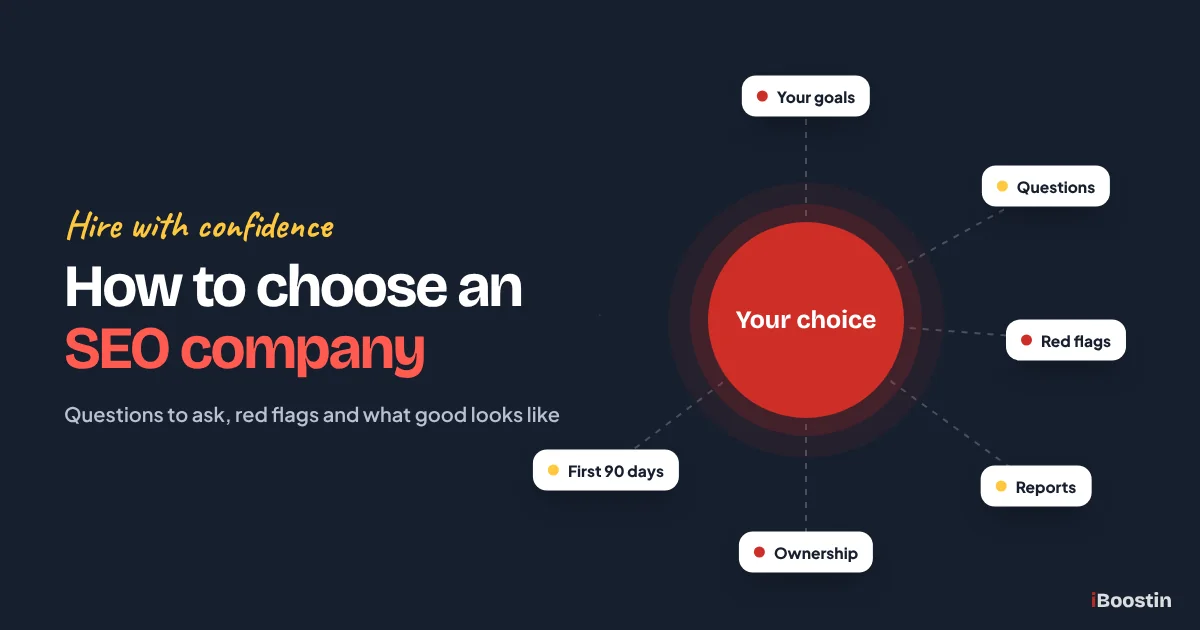
To choose an SEO company, first define what you want SEO to achieve, then shortlist firms with real results in businesses like yours. Ask how they would approach your site, what they will do each month, how they report and who owns the work. Avoid anyone who guarantees rankings, hides their link building or locks you into long contracts.
Most small business owners hire an SEO company the same way: a few calls, a proposal that sounds confident, a monthly fee. Six months later they have a stack of reports, a few rankings for words nobody searches and no clear idea what was actually done. The problem was not SEO. It was that nobody asked the right questions before signing, so there was nothing to hold the company to.
This guide gives you a straightforward way to choose, from preparing your goals to the exact questions to ask, the answers that should reassure you, the red flags and what the first ninety days should look like. We wrote it as an SEO company ourselves, so we are clear about what good looks like from the inside. If you are still deciding whether SEO is right for you at all, read is SEO worth it for small business first.
Key takeaways
- Decide what success means for your business before talking to any SEO company: leads, calls, bookings or sales, not just rankings.
- A good company explains its plan in plain language, shows a clear monthly work list and reports on impressions, clicks and leads.
- Ask who owns your website changes, content, accounts and links if you part ways. The answer should be: you do.
- Red flags include guaranteed rankings, secret link building methods, very cheap packages with vague deliverables and long lock-in contracts.
- Judge a new SEO company on progress signals in the first three months and on leads over six to twelve months.
What Does an SEO Company Actually Do?
An SEO company improves how your website and business appear in search results so more of the right people find and contact you. The work usually covers technical fixes, keyword research, page improvements, content, local SEO and building authority through links and mentions. Good companies also measure what that work brings in.
The Main Areas of Work
Technical SEO makes sure Google can crawl and index your site and that pages load fast on phones. Keyword research finds the searches your customers use. On-page SEO improves titles, headings and content on each important page. Content work creates new service pages and articles. Local SEO covers your Google Business Profile, reviews and directory listings. Off-page SEO builds authority through links and mentions from other sites.
Increasingly, SEO companies also work on visibility in AI answers, such as Google AI Overviews, AI Mode and ChatGPT. Most of that work overlaps with traditional SEO, but a good company should be able to explain how it handles it. We cover this side in how to get your business mentioned in ChatGPT.
What You Should Still Do Yourself
Even with an SEO company, some things work best coming from you. Asking customers for reviews, sharing details about your services and areas, approving content and passing on customer questions all make the work better. A company that never asks you anything is guessing about your business.
Expect to spend a little time each month on calls, approvals and feedback, especially at the start. The most successful client relationships we have are the ones where the owner stays involved enough to steer, without having to do the SEO work themselves.
Before You Contact Any SEO Company
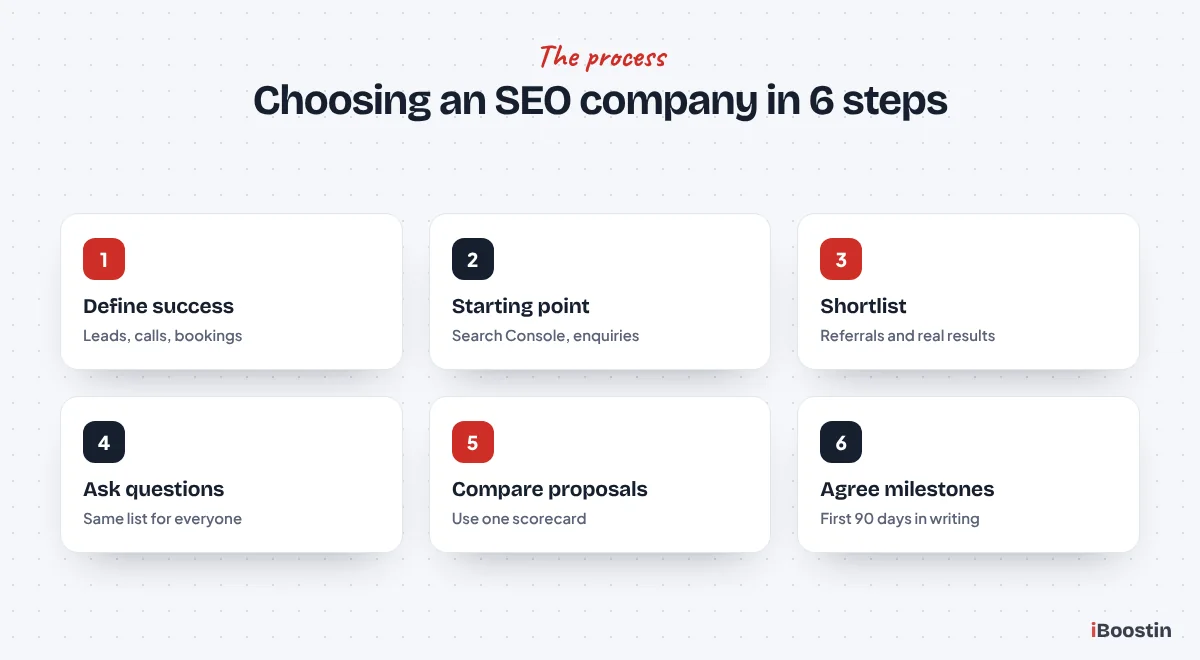
Most bad hires happen because the business owner had no clear goal, so any proposal looked reasonable. Spend an hour on these three things first. They make every conversation sharper and every proposal easier to compare.
Define What Success Means for You
Decide what you want SEO to bring: more calls, more booked appointments, more online sales, more quote requests or more visibility in a new area or service. Write down your most important services and the areas you serve. That gives any SEO company a target to plan around.
Be wary of setting rankings as the main goal. A first page position for a phrase nobody searches, or that brings the wrong visitors, does not grow your business. Enquiries and customers from search are the goal. Rankings and traffic are how you get there.
Know Your Starting Point
Gather what you can: access to Google Search Console and Google Analytics if you have them, your Google Business Profile, a rough idea of how many enquiries you get now and where they come from. If you have worked with an SEO company before, find out what they did.
This lets you measure progress honestly later, and it helps a good company diagnose your situation quickly. If you have no data at all, that is fine. Setting up tracking will be part of the first month’s work.
Decide What You Can Commit
SEO takes months to show clear results, so think about how long you can commit and roughly what you can invest each month. A small, consistent budget held for a year usually achieves more than a big budget for three months. Our guide on how long SEO takes explains the realistic timeline.
Knowing your limits helps you choose the right type of partner and the right scope. It also protects you from being upsold into a package that looks impressive but cannot be sustained.
Where to Find SEO Companies Worth Talking To
Good SEO companies come from many places. The best starting points give you evidence of real work, not just good marketing.
Referrals and Results You Can See
Ask other business owners you trust who they use and whether they are happy. Look at businesses in other industries that rank well in your area and ask who does their SEO. Referrals from people who have seen real results are the most reliable starting point.
Review platforms and directories for agencies show client reviews and portfolios. Read the detailed reviews, not just the star rating, and look for comments about communication, reporting and results over time.
Local or Remote, Agency or Freelancer
Your SEO company does not need to be in your city. Plenty of strong teams work remotely for clients in other countries, and what matters is their experience with businesses like yours and their communication. A local firm can be useful if you value in-person meetings or need deep local knowledge.
Freelancers can be excellent for focused work and smaller budgets, but they have limited capacity and may not cover every area. Agencies usually offer a broader team, such as technical, content and outreach specialists, and more continuity. Choose based on the scope you need and how much hands-on support you want.
Questions to Ask an SEO Company Before You Hire
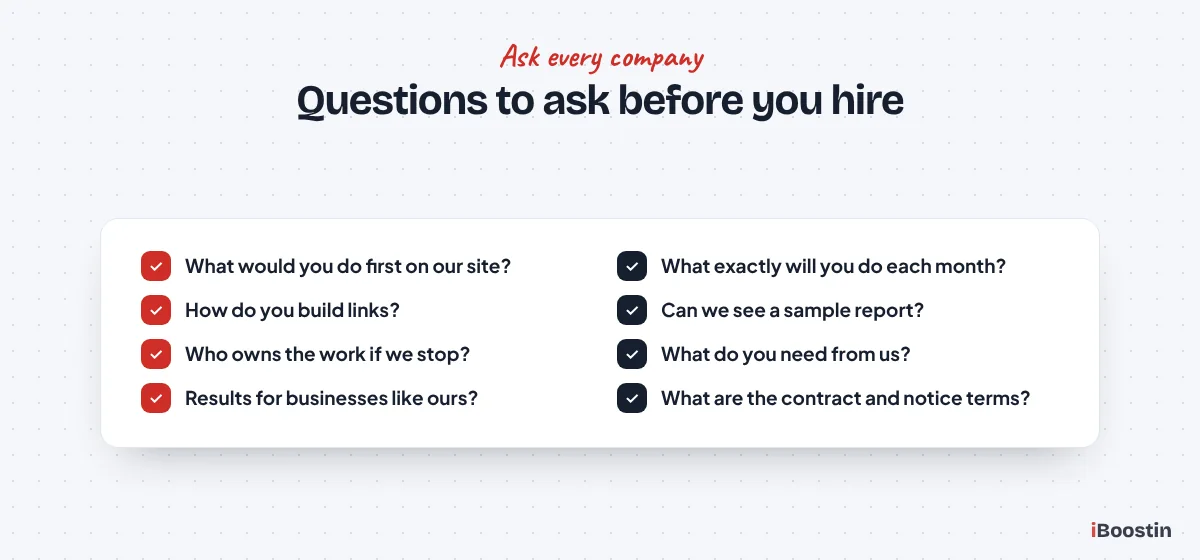
This is the most important part of choosing. The questions below separate companies that know what they are doing from those that sell packages. For each, we describe what a good answer sounds like, so you can judge the response.
What Would You Do First on Our Website?
A good company will look at your site before answering and point to specific issues: indexing problems, missing service pages, a weak Google Business Profile, keywords you are not targeting. They should explain the order they would tackle things in and why.
A generic answer that could apply to any business, like “we will optimize your site and build links”, suggests they have not looked. You want a plan that clearly fits your business, your competitors and your goals.
What Exactly Will You Do Each Month?
Ask for a sample monthly work list. It should name concrete tasks: technical fixes, pages created or improved, Business Profile updates, outreach and links earned, content published. You should be able to check that each item happened.
Vague deliverables like “ongoing optimization” or “SEO maintenance” make it impossible to know what you are paying for. A good company is happy to be specific, because specific work is what gets results.
How Do You Build Links?
Links remain one of the strongest ranking signals, and also the area with the most risky practices. A good company explains its methods openly: outreach to relevant sites, digital PR, partner and local links, useful content that earns links. They should be willing to show examples of links built for other clients.
If the answer is a secret method, a fixed number of links per month from “high authority” sites, or links from networks they own, walk away. Those methods can lead to penalties that take months to undo. Our guide on how to get backlinks for a new website explains what safe link building looks like.
How Will You Report Results?
Ask to see a sample report. A good report shows what was done, then the results: impressions, clicks and average position from Search Console, Google Business Profile activity, and leads such as calls and forms from organic search. It should explain the numbers in plain language.
Be cautious of reports that only show ranking positions for hand-picked keywords or large traffic numbers without context. Ask how they will connect SEO work to enquiries for your business.
Who Owns the Work If We Stop?
You should own your website, its content, your Google accounts and the improvements made. Ask directly: if we part ways, do we keep the content, the changes and access to all accounts? The answer should be yes, without conditions.
Some companies set up Search Console, Analytics or your Business Profile under their own accounts, or host content on sites they control. That makes leaving painful. Make sure every account is in your name, with the company added as a user.
What Do You Need From Us?
A good company will need some input: access to your website and accounts, information about your services, approval of content and help with reviews. Ask what they need and how often. Clear expectations on both sides prevent delays.
If a company says they need nothing from you, be careful. Strong SEO depends on knowing your business, your customers and what makes you different. Without that, the content and strategy will be generic.
What Results Have You Achieved for Similar Businesses?
Ask for examples from businesses similar to yours in size, industry or market. Look for clear before and after evidence, ideally from Search Console or analytics, and ask what work led to those results and how long it took.
Be wary of results that seem too good to be true, or examples only from very different industries. Every market is different, but a company with relevant experience will understand your situation faster.
Agency, Freelancer or In-House SEO?
Before comparing individual companies, it helps to decide which type of SEO help fits your business. Each option has real strengths, and the right one depends on your size, budget and how much SEO work you need.
SEO Agencies
An agency gives you a team: usually a strategist, technical specialists, writers and outreach people. That breadth suits businesses that need several kinds of work at once, such as technical fixes, content and link building, and it gives continuity when one person is away or leaves.
The trade-off is that you may deal with an account manager rather than the person doing the work, and smaller clients sometimes get less attention. Ask who will actually work on your account, how often you will speak with them and how many clients each specialist handles.
Freelancers and In-House Staff
A skilled freelancer can be a great fit for a focused job or a smaller budget, and you usually work directly with the person doing the work. The limits are capacity and breadth: one person rarely covers technical SEO, content and outreach equally well, and progress stops when they are busy or unavailable.
Hiring an in-house SEO person makes sense once SEO is a major channel and there is enough work for a full role. Many small businesses are not there yet. A common path is to start with an agency or freelancer, learn what the work involves and bring it in-house later if it grows.
Questions to Ask About AI Search
Search is changing, and a good SEO company should have a clear view on AI features like Google AI Overviews, AI Mode and ChatGPT. You do not need a separate AI agency, but you should check that your SEO partner is not ignoring this shift.
How Do You Handle AI Overviews and ChatGPT?
A good answer explains that AI tools rely on many of the same signals as Google rankings: clear, well structured pages, consistent business information, reviews and mentions on trusted sites. The company should mention practical steps, such as making sure AI crawlers can reach your site, structuring pages so answers are easy to quote and building mentions on lists and directories AI tools read.
Be cautious of companies that either dismiss AI search completely or sell it as a mysterious new service that replaces SEO. The honest position sits in the middle: most of the work overlaps, with some extra attention to entity consistency and third-party mentions.
How Will You Measure AI Visibility?
AI answers vary from one question to the next, so there is no single ranking to report. A thoughtful company will suggest tracking a fixed set of customer questions over time, noting how often your business appears and how it is described, alongside your normal Search Console data.
Ask whether this is included in reporting, how often it is checked and what they will do if competitors keep appearing instead of you. You want a partner who treats AI visibility as part of the same plan, measured honestly, rather than a vague promise.
Red Flags When Choosing an SEO Company
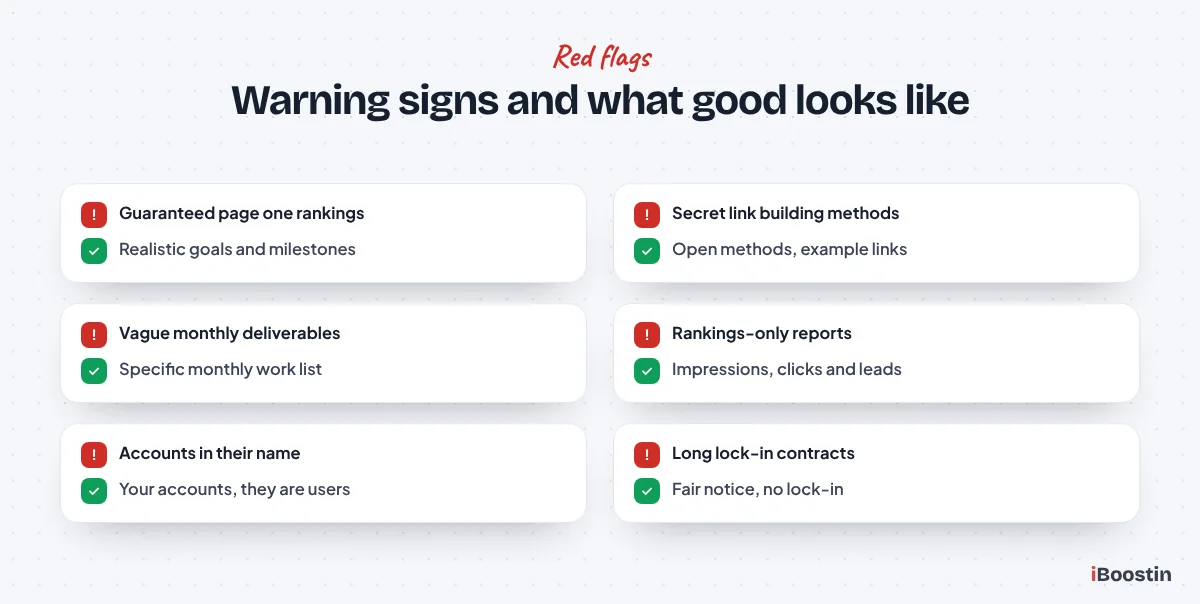
Some warning signs show up again and again in stories from owners who regretted their choice. Any one of them is reason to slow down. Several together are reason to walk away.
Guaranteed Rankings or Results
Nobody can guarantee a specific Google ranking, because nobody controls Google’s algorithm. Companies that promise “page one in thirty days” or “number one guaranteed” are either targeting meaningless keywords or using tactics that risk your site. Google itself warns business owners about this.
A trustworthy company sets realistic expectations based on your site, your competitors and your timeline, and explains what progress should look like along the way. Confidence based on experience is fine. Guarantees are not.
Secret Methods and Vague Work
If a company cannot or will not explain what it is doing, assume you would not like the answer. “Proprietary techniques” usually means bought links, automated content or other practices that break Google’s guidelines.
Equally, very cheap packages with long lists of vague deliverables often mean little real work is done. SEO takes skilled time. A package that seems too cheap for what it promises usually delivers far less.
Long Contracts and Lock-In
Long contracts with heavy penalties for leaving protect the company, not you. Some minimum commitment is reasonable, because SEO needs time to work. But you should be able to leave if the company does not deliver what it promised.
Look for clear terms: a reasonable notice period, no loss of your content or accounts if you leave, and a clear statement of what you are paying for each month. A company confident in its work does not need to trap clients.
Signs It Is Time to Switch SEO Companies
Sometimes the problem is not choosing a new company but realizing the current one is not working. These are the signs we hear most often from business owners who come to us after a disappointing experience.
Warning Signs After Six Months
After six months, you should be able to see what was done and some movement in Search Console: more impressions, better average positions and at least some growth in clicks. If reports show the same template every month, the company cannot explain what changed, or rankings are reported only for phrases nobody searches, something is wrong.
Other warning signs include slow or vague replies, staff changing constantly, link building you cannot see and accounts set up in the company’s name. Any of these deserves a direct conversation. A good company will respond with specifics and a plan to fix it.
How to Switch Without Losing Ground
Before you give notice, make sure you have admin access to everything: your website, hosting, domain, Search Console, Analytics and Google Business Profile. Ask for a list of all work done, content created and links built. Download your reports.
Then brief the new company with that history so they do not repeat or undo past work. Avoid changing URLs or redesigning the site at the same moment, because that makes it hard to tell what caused any change. A clean handover protects the progress you already paid for.
How to Compare SEO Proposals
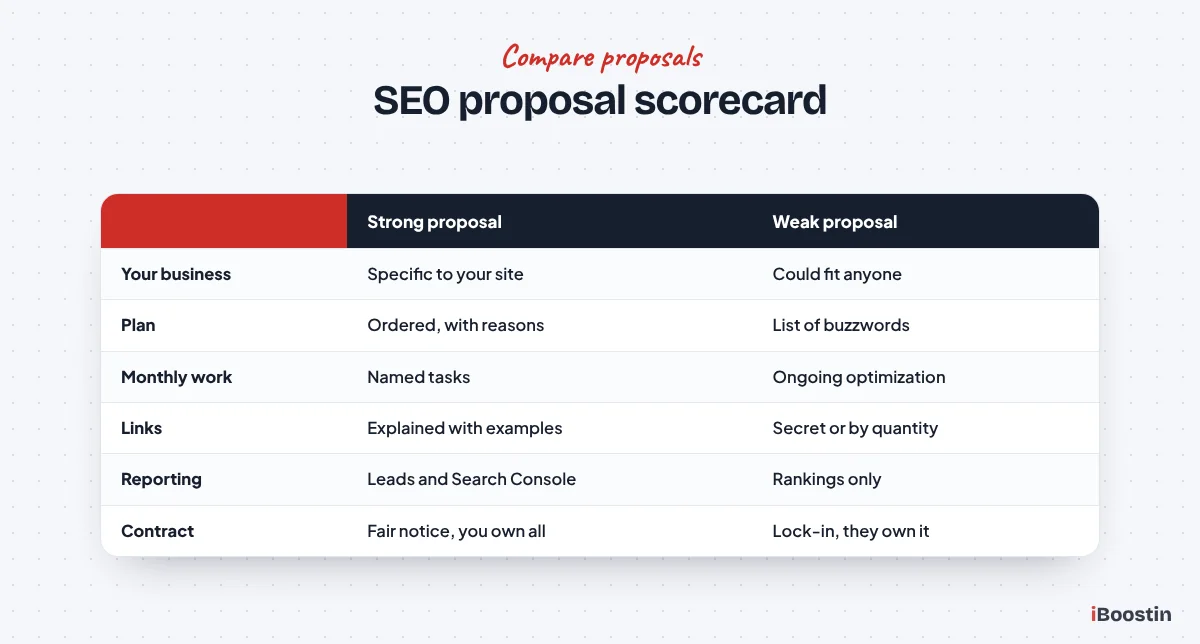
Once you have two or three proposals, put them side by side. They often look very different, which makes comparison hard. A simple scorecard helps you compare what really matters.
Compare the Plan, Not Just the Price
Ask yourself: which company understood my business best? Which plan targets the searches my customers actually use? Which one explained what happens in the first three months? The cheapest proposal is rarely the best value, and the most expensive is not automatically the best.
Check how each proposal handles your biggest problems. If your site has indexing issues, the plan should fix them first. If you are a local business, Google Business Profile and reviews should be central. A plan that ignores your obvious weaknesses was probably not written for you.
Pricing Models You Will See
SEO companies usually charge in one of three ways: a monthly retainer for ongoing work, a fixed project fee for a specific job like an audit or migration, or hourly consulting. Monthly retainers suit ongoing SEO, projects suit one-off work, and hourly consulting suits businesses with an in-house team that needs guidance.
Whatever the model, make sure you know exactly what is included, how changes in scope are handled and whether there are extra costs for content, links or tools. Compare what you get, not only what you pay.
What the First 90 Days Should Look Like
The first three months tell you a lot about whether you chose well. Results in leads may still be early, but the work and the early signals should be clear.
Month One: Audit and Foundations
Expect a proper audit of your site, a keyword and page plan, fixes to technical problems, Search Console and analytics set up correctly, and improvements to your Google Business Profile. You should receive a clear summary of what was found and what was fixed.
If the first month passes with only a report and no changes, ask why. Most sites have quick wins in technical fixes and profile improvements that a good company tackles straight away.
Months Two and Three: Pages and Early Signals
By months two and three, key service pages should be improved or created, content should be under way and authority building should have started. In Search Console, you should see indexing errors falling and impressions starting to grow.
This is the time to judge the company on progress signals rather than leads. If work is visible and signals are moving, give it time. If nothing has changed and the explanations are vague, raise it early.
Doing SEO Yourself Instead
Not every business needs an SEO company. If your market is not very competitive and you can give SEO a few hours every week, you can handle the basics yourself and bring in help later for specific tasks.
When DIY Makes Sense
Owners can manage Search Console, their Google Business Profile, review requests and clear service pages. These steps bring results in many local markets. Our guide to SEO for small business lays out the plan in the order that pays off fastest.
DIY gets harder with technical problems, competitive keywords and link building. Many owners start themselves and hire help once they see what the work involves, which also makes them better at judging an SEO company.
Hiring Help for Specific Tasks
You do not have to choose between doing everything yourself and handing everything over. A one-off audit, a keyword plan, a technical fix or link building on its own can complement your own work. Many small businesses use specialists this way before committing to ongoing SEO.
If you would like an outside view first, our SEO services start with an honest review of your site and a plan you can follow yourself or with us.
Frequently Asked Questions About Choosing an SEO Company
What questions should I ask an SEO company?
Ask what they would do first on your site, what they will do each month, how they build links, how they report results, who owns the work and accounts if you leave, what they need from you and what results they achieved for similar businesses. Good companies give specific, clear answers to each.
How do I know if an SEO company is legit?
A legitimate company explains its methods openly, shows real results from similar clients, sets realistic expectations without guarantees, reports on impressions, clicks and leads, and lets you own your accounts and content. Check detailed reviews and ask to speak with a current client. Secret methods and guaranteed rankings are warning signs.
Should I hire a local SEO company or a remote one?
Either can work. What matters most is experience with businesses like yours, clear communication and transparent work. A local company may suit you if you value in-person meetings. A remote company can be just as effective, especially for businesses serving national or international markets.
Is it worth hiring an SEO agency for a small business?
It is worth it when your customers search for your services, competitors invest in SEO and you lack the time or skills to do it consistently yourself. A good agency speeds up progress and avoids costly mistakes. In less competitive markets, many owners start with DIY basics and hire help later.
How long should I give an SEO company before judging results?
Judge progress signals, such as fixed indexing errors, rising impressions and improving positions, within the first three months. Judge results in leads and enquiries over six to twelve months, depending on competition and your starting point. If nothing is visibly happening after three months, ask for an explanation.
What should an SEO report include?
A useful report lists the work done that month, then results from Search Console such as impressions, clicks and average position, Google Business Profile activity, and leads from organic search. It should explain what changed, why and what comes next, in plain language rather than only charts.
Can an SEO company guarantee first page rankings?
No. No company controls Google’s rankings, so a guarantee of first page or number one positions is a red flag. Companies that promise this often target low value keywords or use risky tactics. A trustworthy company sets realistic goals and explains how it will measure progress toward them.
Choose the Company That Explains, Not the One That Promises
The right SEO company is rarely the one with the boldest promises. It is the one that understands your business, explains a clear plan, shows exactly what it does each month, reports on what matters and leaves you owning everything it builds. Ask the questions in this guide, compare the answers side by side and you will spot the difference quickly.
If you would like to put these questions to us, we are happy to answer every one of them and show you what our plan for your website would look like before you commit to anything.