In this guide
- How Long Does SEO Take to Work?
- What Affects How Long SEO Takes?
- A Realistic SEO Timeline, Month by Month
- How Long Does SEO Take for a New Website?
- How Long Does Local SEO Take?
- How Long Do SEO Changes Take to Show on Google?
- How Long Does It Take to Show Up in AI Search?
- How to Tell If SEO Is Working Before Leads Arrive
- Can You Speed Up SEO?
- Is SEO Worth the Wait?
- Frequently Asked Questions About How Long SEO Takes
- The Timeline Is Predictable When the Work Is in Order
SEO usually takes three to six months to show clear results for a small business website, and six to twelve months or more to win competitive searches. Technical fixes and Google Business Profile changes can work within weeks. New domains, competitive industries and sites with few backlinks take longer, because Google needs time to trust them.
That range frustrates people, and fair enough. You want a date, not a range. But anyone who gives you a fixed date for page one without looking at your site, your competitors and your history is guessing. What we can give you is something more useful: what happens at each stage, which signals tell you the work is on track long before leads arrive, and what genuinely speeds things up.
This guide breaks the timeline down by situation: a brand new website, an established one, local search, changes to a single page and AI search. It is based on what we see month to month on the small business sites we manage at iBoostin. If you are still deciding whether SEO fits your business at all, start with SEO for small business, which covers the full plan in priority order.
Key takeaways
- Most small business sites see early signals within one to three months and clear results within three to six months.
- Brand new domains, competitive industries and sites with few links sit at the slower end, often six to twelve months or more.
- Technical fixes, Google Business Profile improvements and changes to pages that already rank can show results within days or weeks.
- Impressions rise first, then positions, then clicks and leads. Watch those signals in order instead of waiting for calls.
- There is no safe shortcut. Bought links and spam tactics can trigger penalties that take far longer to recover from than doing it properly.
How Long Does SEO Take to Work?
For a typical small business website, SEO takes three to six months to produce clear, measurable results and six to twelve months to reach strong positions for competitive keywords. Some changes show up much faster. Some industries take much longer. The honest answer depends on where you start and how hard your searches are to win.
What “Working” Actually Means
Owners often mean different things when they ask if SEO is working. For some it means appearing on Google at all. For others it means ranking first for their main keyword, or getting more calls than last year. Each of those has a different timeline, so it helps to be clear about which one you are waiting for.
We split it into three milestones. First, Google indexes your pages and starts showing them for some searches, which you see as impressions in Search Console. Second, your positions improve and some pages reach page one. Third, clicks and enquiries grow steadily. The first can happen within weeks. The third is what usually takes three to six months or more.
Why Every Site Has a Different Timeline
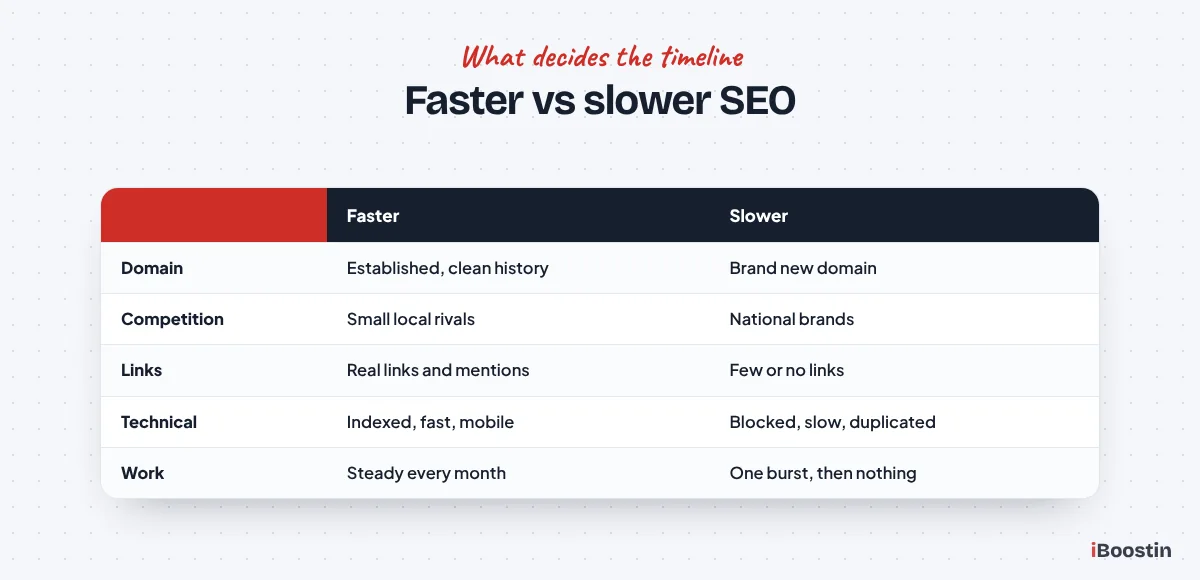
Google ranks pages based on relevance, trust and quality, compared with every other page competing for the same search. Two businesses doing the same work can see very different timelines because one has a ten year old domain with links and reviews, and the other launched last month. One competes with three local firms, the other with national brands.
That is also why timelines published online contradict each other. Some say two to four months, others say a year. Both can be true for different sites. The factors below explain where your site is likely to fall, and the stages that follow show what each month should look like.
What Affects How Long SEO Takes?
A handful of factors decide most of the timeline. You can control some of them. Others you simply need to plan around. Looking at them honestly at the start saves a lot of frustration later.
Domain Age and History
An established domain with years of history, some links and an existing presence usually moves faster, because Google already knows and partly trusts it. Improvements to its pages can show up within weeks. A brand new domain starts with no history at all, so Google tests it cautiously, often showing new pages on lower positions while it gathers signals.
That cautious period is sometimes called a sandbox. Google has never confirmed a formal sandbox, but in practice almost every new site we work with spends its first months collecting impressions on page five to ten before positions climb. Knowing this in advance stops owners from panicking and changing everything at month two.
How Competitive Your Searches Are
Ranking for “emergency plumber” in a small town with a few competitors is a very different job from ranking for “personal injury lawyer” in a major city. Competitive searches have strong, established businesses at the top, often with years of content, links and reviews. Overtaking them takes longer, no matter how good your work is.
A practical way to judge competition is to look at who ranks today. If the top results are small businesses with thin pages, you can move quickly. If they are national brands, directories and big publishers, plan for a longer climb and start with smaller, more specific searches you can win first.
Your Website’s Authority and Links
Links from other websites remain one of the strongest signals Google uses to decide which pages to trust. A site with no links tends to stall on page three to six, even with good content. This is the most common reason we see small business sites with plenty of impressions and almost no clicks.
Authority builds gradually through real links and mentions: suppliers, partners, associations, local organizations, directories and press. It is the slowest part of SEO and the part that most decides the timeline for competitive searches. Our guide on how to get backlinks for a new website covers the safe ways to build it.
Technical Health and Content Quality
Technical problems slow everything down. If pages are blocked from indexing, load slowly, break on phones or duplicate each other, Google cannot rank them well however much else you do. Fixing these problems often brings the fastest gains of the whole process, because you are removing a brake rather than building from zero.
Content quality sets the ceiling. Pages that answer customer questions fully, show real experience and match what searchers want can climb steadily. Thin pages with a few paragraphs usually stall. If your site is not appearing at all, check our guide on why your website is not showing up on Google before anything else.
How Much Work Goes In Each Month
SEO is cumulative. A site that adds a strong page, earns a couple of links and collects new reviews every month moves faster than a site that gets one burst of work and then nothing. Consistency matters more than intensity, because Google responds to steady growth in quality and trust over time.
This is why we plan SEO as a monthly routine rather than a one-off project. The early months focus on foundations and key pages, later months on authority and expanding into more searches. Each month builds on the last, and the results compound.
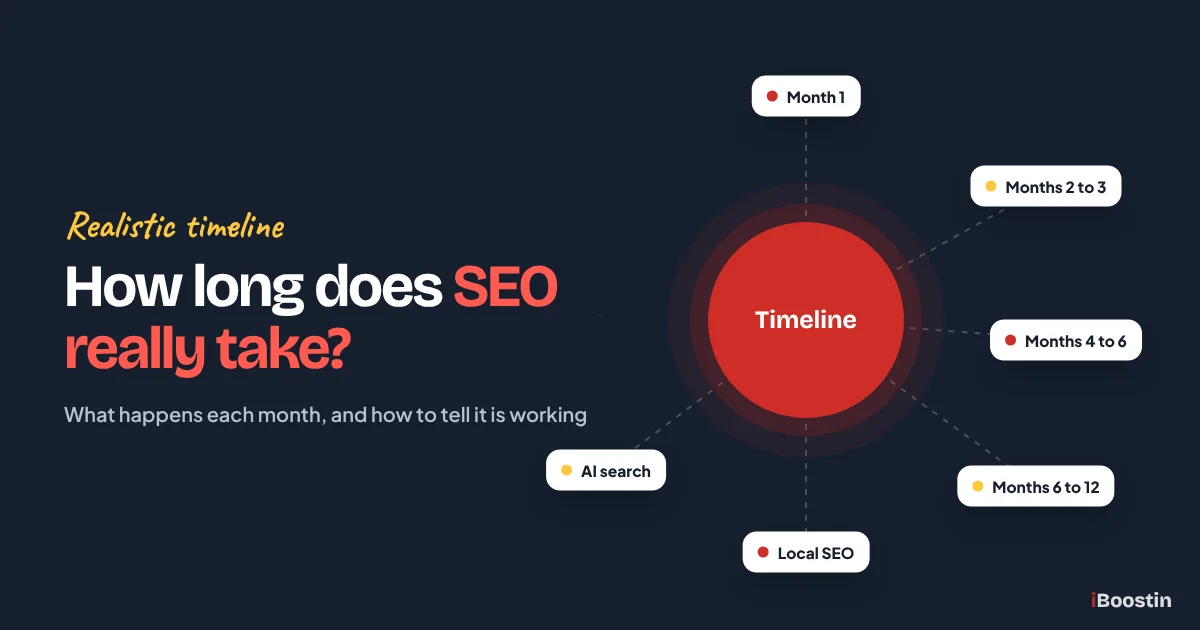
A Realistic SEO Timeline, Month by Month
The stages below describe what usually happens on a small business website when the work is done consistently and in the right order. Your timing may be faster or slower depending on the factors above, but the order of events is remarkably consistent.
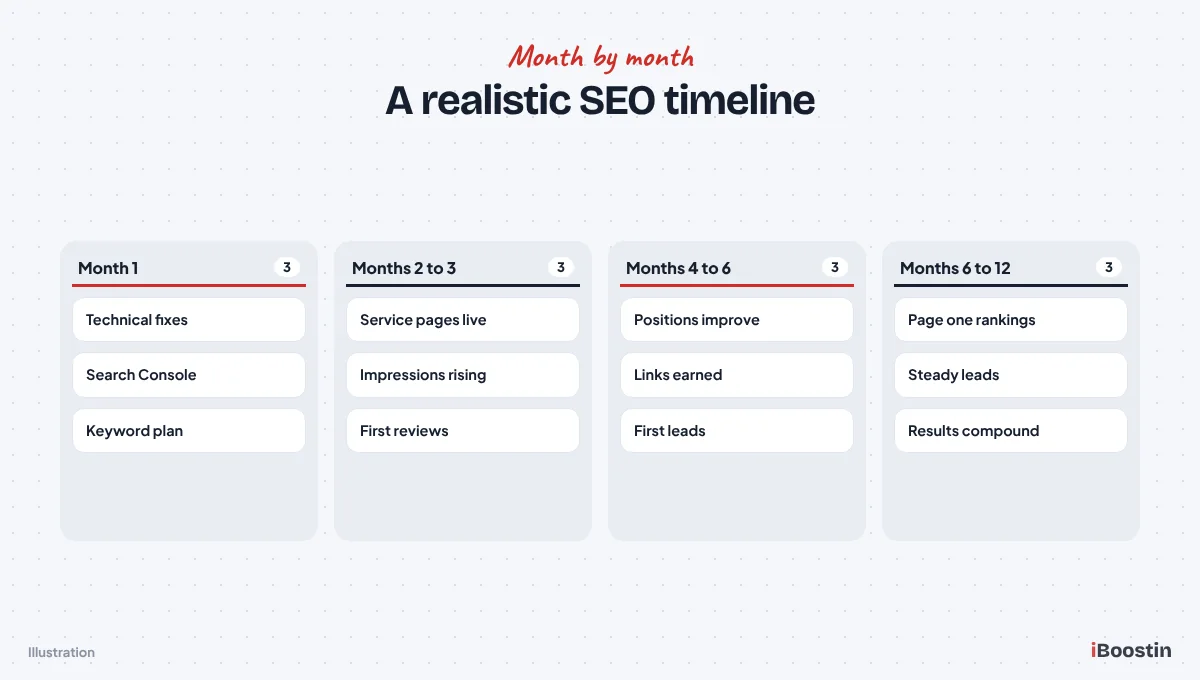
| Stage | What we work on | What you should see |
|---|---|---|
| Month 1 | Technical fixes, Search Console, keyword plan, Business Profile | Indexing errors cleared, pages crawled |
| Months 2 to 3 | Service pages built or rewritten, on-page SEO, first reviews | Impressions rising, new queries appearing |
| Months 4 to 6 | Authority building, supporting content, internal links | Average position improving, first page one rankings |
| Months 6 to 12 | More pages, more links, refining what works | Steady clicks, calls and form leads from search |
| Year 2 and on | Expanding into bigger, more competitive searches | Compounding growth, less reliance on paid ads |
Month 1: Foundations
The first month is about making sure Google can find, crawl and index your site, and setting the plan. That means verifying Search Console, fixing indexing errors, speeding up slow pages, completing the Google Business Profile and researching the keywords you will target. Very little changes in traffic yet, and that is normal.
Some sites do see a quick jump in month one. If indexing was blocked, or the Business Profile was half empty, fixing those can bring results within days. For most sites, though, month one is groundwork that makes every later month more effective.
Months 2 to 3: Pages and First Signals
This is when service pages are built or rewritten, titles and headings are improved and the first supporting content goes live. Google starts testing these pages for more searches, which shows up as rising impressions and new queries in Search Console. Positions are often still on pages two to five.
This is also when many owners lose patience, because the phone is not ringing yet. The rising impressions are the signal to watch. They mean Google is considering your pages for more searches, which always comes before better positions and clicks.
Months 4 to 6: Positions Start to Climb
With pages in place and authority starting to build, average position begins to improve. Less competitive searches often reach page one in this window, and the first organic leads usually arrive. Local businesses with a strong Business Profile and steady reviews often see map pack results move here too.
This is the stage where the work shifts toward authority: earning links and mentions, adding supporting articles that link to service pages and improving the pages that sit on positions eight to twenty. Those pages are close to page one and often move with modest improvements.
Months 6 to 12: Steady Leads
By this stage, a well managed small business site usually has a stable set of page one rankings and a steady flow of clicks and enquiries from search. The focus becomes expanding: new service and location pages, more content, more authority, and moving up on the more competitive searches.
Results now compound. Each new page benefits from the authority the site has already built, so it ranks faster than the first pages did. This is when SEO starts to feel less like an expense and more like an asset that keeps paying back.
Year Two and Beyond
Competitive searches, the big head terms in your industry, often take more than a year. By year two, the site has the history, links and reviews to compete for them. Many of our clients rely far less on paid ads by this point, because organic search brings a dependable base of leads.
SEO never fully stops, because competitors keep improving and search keeps changing. But the effort needed to hold good positions is usually less than the effort it took to earn them, as long as you keep the basics going.
How Long Does SEO Take for a New Website?
A brand new website usually takes six to twelve months to rank for meaningful searches, and longer in competitive industries. It typically appears for its own business name within days or a few weeks of being indexed, but service keywords take much longer because the domain has no history, links or reviews yet.
Why New Sites Start Slowly
Google has no track record for a new domain. It does not know whether the business is real, whether people trust it or whether its pages are better than what already ranks. So it shows new pages cautiously, gathering signals before moving them up. That is why new sites often see plenty of impressions on low positions in the first months.
The good news is that a new site has no bad history either. Built cleanly, with strong pages and real authority from the start, it can catch up with older competitors that never invested properly. We see new sites overtake neglected ten year old sites regularly, usually somewhere in the second half of the first year.
What Helps a New Site Rank Sooner
Start with searches you can realistically win: your service plus your town, specific sub-services and customer questions. Get the site linked from places Google already trusts, such as your Google Business Profile, social profiles, industry directories, suppliers and partners. Collect reviews from the start.
Make every key page genuinely useful from day one rather than launching thin pages and filling them in later. And give it time without constant redesigns. Every major change to URLs and structure resets some of what Google has learned about your site.
How Long Does Local SEO Take?
Local SEO often shows results faster than general SEO, frequently within one to three months for the map pack when a Google Business Profile was incomplete before. Competitive cities and industries take longer. Distance from the searcher also limits how far your visibility can spread, however good your profile is.
Why Local Can Move Faster
Local results compare you with nearby businesses only, not the whole country. Many of those competitors have incomplete profiles, few reviews and no website content for their services. Simply completing your profile, choosing the right category, adding services and photos and collecting reviews can move you ahead of them quickly.
Consistent business details across directories and a website with clear service and location information support the profile. Our guide on how to rank higher on Google Maps walks through every setting that affects how quickly you climb.
Reviews Take Steady Time
Reviews are one of the strongest local signals, and they cannot be rushed safely. A business that gets two or three genuine reviews a week will pull ahead over a few months, while a sudden burst of reviews followed by nothing looks unnatural. Never buy reviews or offer incentives for positive ones.
Build asking into your routine: a short message with your review link after every finished job. It costs nothing, and over six months it changes how both Google and customers see your business.
How Long Do SEO Changes Take to Show on Google?
Autocomplete shows many people asking how long it takes for SEO changes to take effect or to update on Google. For a page that is already indexed, Google usually recrawls and reflects changes like a new title or improved content within a few days to a few weeks. The ranking effect can take longer to settle.
Small Changes to Existing Pages
Changes to titles, meta descriptions, headings and content on pages that are already indexed are picked up when Google next crawls the page. Popular pages get crawled more often, so their changes show faster. You can prompt a recrawl by using URL Inspection in Search Console and clicking Request Indexing.
Do not judge a change after two days. Rankings often fluctuate for a week or two after an update as Google tests the new version. Note the date of each change and compare the following four weeks with the four weeks before, so you know whether it helped.
Bigger Changes Like New Pages or a Redesign
New pages need to be discovered, crawled and indexed before they can rank, which can take days to weeks depending on how well they are linked. A redesign or a move to a new domain can take weeks or months to settle fully, especially if URLs change. Proper 301 redirects from every old URL keep most of the value.
Plan big changes carefully and make them once. Repeated restructuring keeps resetting Google’s understanding of your site, which is one of the most common reasons we see SEO timelines stretch out longer than they should.
How Long Does It Take to Show Up in AI Search?
Showing up in Google AI Overviews, AI Mode or ChatGPT answers usually follows the same path as organic SEO. Pages that rank well and businesses that are widely mentioned get cited more often. There is no separate timeline you can skip ahead on, but clear, well structured content can be quoted as soon as it is indexed.
What AI Tools Need Before They Mention You
AI assistants build answers from pages they can read and from what trusted sources say about a business. When your website states clearly what you do, where and for whom, and your business is consistently described on directories, review sites and articles, AI tools can mention you with confidence. That reputation takes the same months to build as authority on Google.
Content structure helps you get quoted sooner. Pages that open each section with a direct answer, use clear headings and include specific facts are easier for AI systems to use. We explain the full process in how to get your business mentioned in ChatGPT.
Why AI Visibility Varies Day to Day
AI answers change from one query to the next, even for the same question. Being mentioned once is not the same as being mentioned consistently. Track it over time by asking the same questions every few weeks and noting which businesses appear.
The businesses that appear consistently are usually the ones that also rank well and have strong reviews and mentions. So the most reliable way to speed up AI visibility is the same work that speeds up SEO: clear pages, a complete profile, honest reviews and real mentions on trusted sites.
How to Tell If SEO Is Working Before Leads Arrive
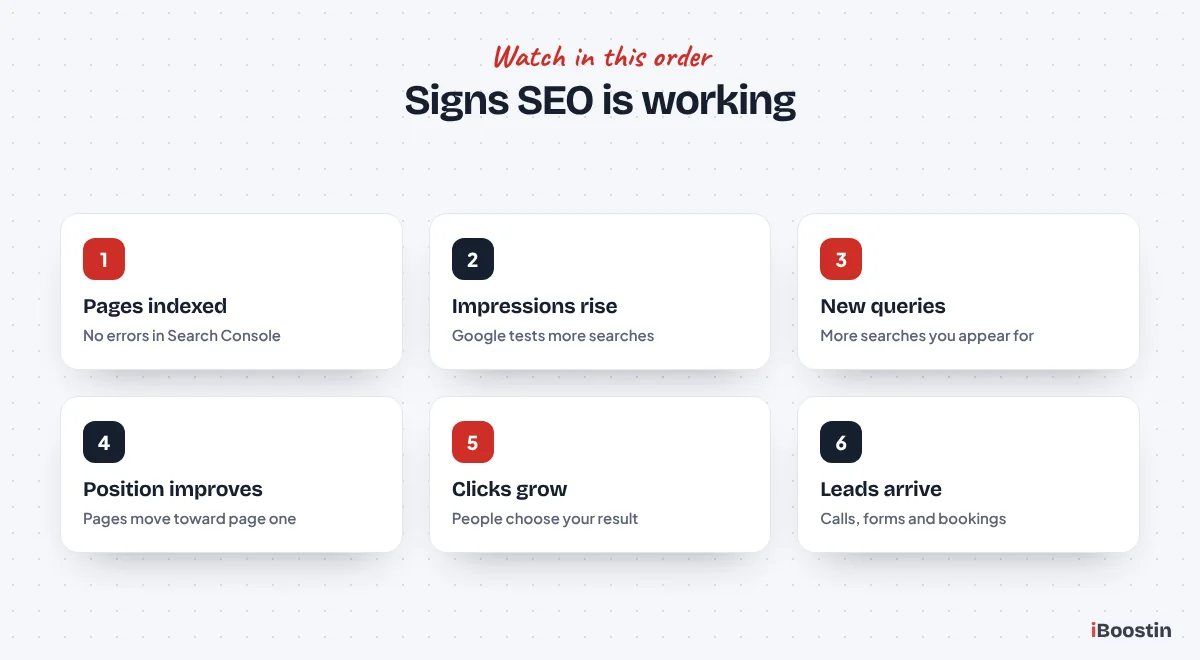
Leads are the last thing to arrive, so judging SEO only by calls means you will think it is failing for months when it is actually on track. Watch these signals, in this order, to know whether your timeline is progressing.
Leading Signals to Watch
First, your important pages are indexed with no errors in Search Console’s Pages report. Second, total impressions grow month over month and new queries appear in the Queries report. Third, average position improves and some pages move from page three or four onto page two and then page one.
If these signals are moving in the right direction, your SEO is working even if leads have not arrived yet. If impressions are flat after three months of consistent work, something needs to change: the keywords, the pages or the technical setup. That is the moment to review the plan, not to give up.
Lagging Signals That Confirm It
Clicks, calls, form submissions and bookings from organic search are the lagging signals. They arrive after positions improve, often a month or two later. Track them in your analytics, your call records and your inbox, and ask new customers how they found you.
Compare each month with the same month a year earlier once you have a year of data, so seasonal swings do not mislead you. When the lagging signals start rising steadily, the timeline has delivered. From there, the job is to keep building so the growth continues.
Can You Speed Up SEO?
You can speed up SEO by removing what slows it down and focusing effort where it counts, but you cannot skip the time Google takes to build trust. Anything that promises page one in a few weeks for competitive searches is either misleading or risky.
What Genuinely Speeds It Up
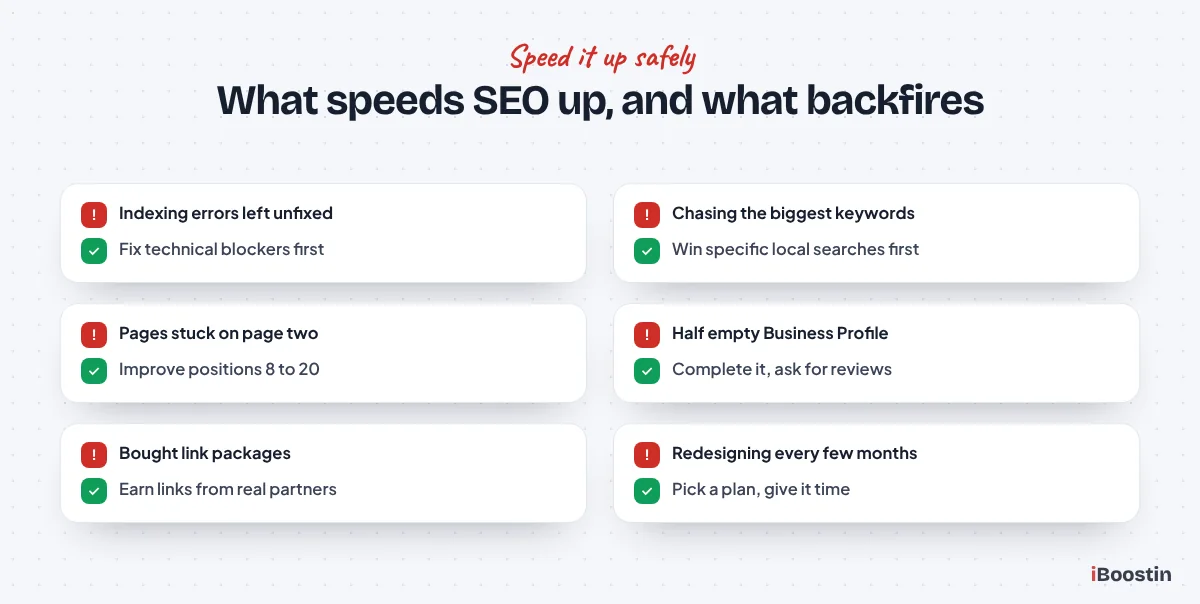
Fix technical blockers first, since they bring the fastest gains. Target searches you can realistically win before chasing the big terms. Improve pages already ranking on positions eight to twenty, which are close to page one. Complete your Google Business Profile and build a steady review routine. Earn links from real partners and organizations.
Run paid search ads alongside SEO in the early months if you need leads sooner. Ads do not improve your organic rankings, but they bring enquiries while SEO builds, and they tell you which keywords convert best, which sharpens your SEO focus. We compare the two in SEO vs PPC for small business.
Shortcuts That Slow You Down Later
Bulk link packages, private blog networks, link exchanges, fake reviews and auto-generated content can sometimes move rankings briefly. Google is good at detecting them, and the result is often a manual action or a ranking drop that takes months to recover from. That turns a short cut into a much longer road.
The same applies to constant changes. Redesigning the site every few months, rewriting pages before Google has had time to evaluate them or switching keywords every month all reset progress. Pick a plan, give it time, and judge it on the signals above.
Is SEO Worth the Wait?
For most small businesses, yes, because the results compound. Ads stop when the budget stops. Rankings built through steady SEO keep bringing enquiries month after month, and each new page ranks faster than the last. Our guide on whether SEO is worth it for small business helps you check this for your own situation.
Planning Around the Wait
Plan your marketing so you are not relying on SEO for income in the first few months. Use referrals, ads or outreach to bring leads while SEO builds. Commit to at least six months before judging the results, and agree on the leading signals you will check each month.
If you work with an agency, ask for a month by month plan like the one above and a report that shows impressions, positions, clicks and leads. You should always know what was done this month and what it is meant to achieve. That clarity makes the wait much easier.
When to Get Help
If you have been doing SEO for months with flat impressions, or you simply do not have the time to keep a monthly routine going, a specialist can usually find what is holding things back and speed up the timeline. Our SEO services start with a review of your current data and a realistic plan, and our monthly SEO services keep the work going every month.
A good partner will also tell you when your expectations are unrealistic. If your industry and starting point mean page one is a year away, you should hear that before you sign, along with the smaller wins you can expect along the way. That honesty is a better sign of a trustworthy SEO team than any promise of fast rankings.
Frequently Asked Questions About How Long SEO Takes
Is 3 months enough for SEO?
Three months is usually enough to see early signals, such as indexed pages, rising impressions and some improved positions, and sometimes first leads for less competitive searches. It is rarely enough for strong results on competitive keywords. Judge the first three months on whether the leading signals are moving, then give it six to twelve months for clear results.
How long does SEO take for a new website?
A new website usually appears for its own business name within days or a few weeks of being indexed. Ranking for service keywords typically takes six to twelve months, longer in competitive industries. New domains have no history or links, so Google tests them cautiously. Starting with specific, local searches helps a new site gain ground sooner.
How long does it take for SEO changes to take effect?
Changes to pages that are already indexed are usually picked up within a few days to a few weeks, when Google recrawls the page. Ranking effects can take longer to settle as Google tests the updated page. Request indexing in Search Console to prompt a recrawl, and compare four weeks before and after each change.
How long does local SEO take to work?
Local SEO often shows map pack improvements within one to three months, especially when a Google Business Profile was incomplete before. Competitive cities and industries take longer. Reviews, consistent directory listings and clear location content keep pushing visibility up over the following months. Distance from the searcher always limits how widely you can appear.
Why is my SEO taking so long?
The most common reasons are a new domain, competitive keywords, few links from other websites, technical problems blocking indexing, thin pages and inconsistent work. Check Search Console for indexing errors, look at whether your target keywords are realistic and review how many genuine links you have earned. Fixing the biggest of these usually speeds things up.
Do I need to keep doing SEO once I rank?
Yes, though usually with less effort than it took to get there. Competitors keep improving, content ages and search changes over time. Keeping pages updated, collecting reviews and earning occasional new links protects your positions. Sites that stop completely tend to slip gradually over the following months, especially in competitive markets.
How long does it take to rank on the first page of Google?
For less competitive local searches, a well built small business site can reach the first page within three to six months. Competitive searches often take six to twelve months or more. It depends on your domain’s history and authority, the strength of the businesses already ranking and how consistently the work is done.
The Timeline Is Predictable When the Work Is in Order
SEO feels unpredictable when work is done in random order and judged by the wrong numbers. Done in order, with foundations first, then pages, then authority, and judged by impressions, positions and then leads, it follows a pattern you can plan around. Most small business sites see clear results within three to six months and strong, compounding results within a year.
If you want to know where your site sits on that timeline today, and what would move it faster, we can review your Search Console data and competitors and give you a realistic plan. No promises of overnight rankings, just a clear picture of what it will take.