In this guide
- What Is SEO for Dentists?
- Start With Your Google Business Profile
- Build One Strong Page for Every Treatment
- Show Google and Patients You Can Be Trusted
- Reviews: The Fastest Lever for Dental Practices
- Content That Brings Patients Who Are Still Deciding
- Links and Mentions That Build Authority
- Get Your Practice Recommended in AI Search
- Measure Dental SEO in Appointments, Not Rankings
- Common Dental SEO Mistakes
- Doing Dental SEO Yourself vs Getting Help
- Frequently Asked Questions About SEO for Dentists
- Start Where Your Next Patients Are Searching
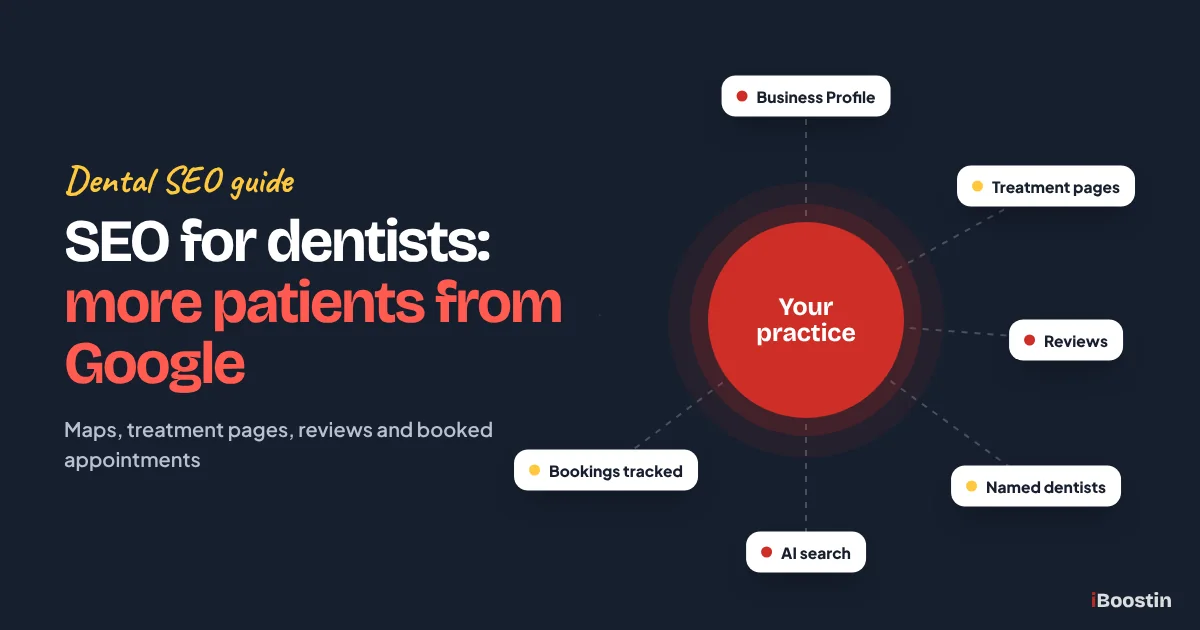
SEO for dentists is the work of making your practice the one patients find when they search for a dentist, a treatment or an emergency appointment near them. It covers your Google Business Profile, one strong page for every treatment you offer, reviews, a fast mobile website, trust signals that Google looks for on health websites, and tracking that shows how many calls and bookings search actually brings.
Here is the situation we see most often. A practice has good dentists, modern equipment and loyal patients, but the phone only rings from referrals. When someone nearby searches “dentist near me” or “dental implants” plus the town name, three other practices appear in the map results, and the practice website sits on page two with a single “Services” page listing twenty treatments in bullet points. Nothing is wrong with the dentistry. The problem is that Google has very little to show for the searches patients actually make.
This guide is the plan we follow for dental practices, in the order that brings new patients fastest. It explains what to fix on your Google Business Profile, how to build treatment pages that rank and convert, how reviews and trust signals work for a health website, how AI search is starting to recommend practices, and how to measure the result in booked appointments rather than vague traffic numbers. If you want the general version of this plan for any small business, start with our SEO for small business guide, then come back here for the dental details.
Key takeaways
- Most new dental patients come from the map pack and from treatment searches, so your Google Business Profile and treatment pages matter more than your homepage.
- Give every major treatment its own page: implants, Invisalign, veneers, whitening, root canal, emergency care and children’s dentistry each need a dedicated, detailed page.
- Dental websites are judged as health content. Named dentists, qualifications, clear pricing guidance and accurate medical information help both rankings and trust.
- Reviews decide which practice gets the call. A simple, honest routine for asking every happy patient beats any shortcut.
- Track calls, form bookings and WhatsApp messages from search, not just rankings, so you know which treatments SEO is actually filling.
What Is SEO for Dentists?
How patients search for a dentist
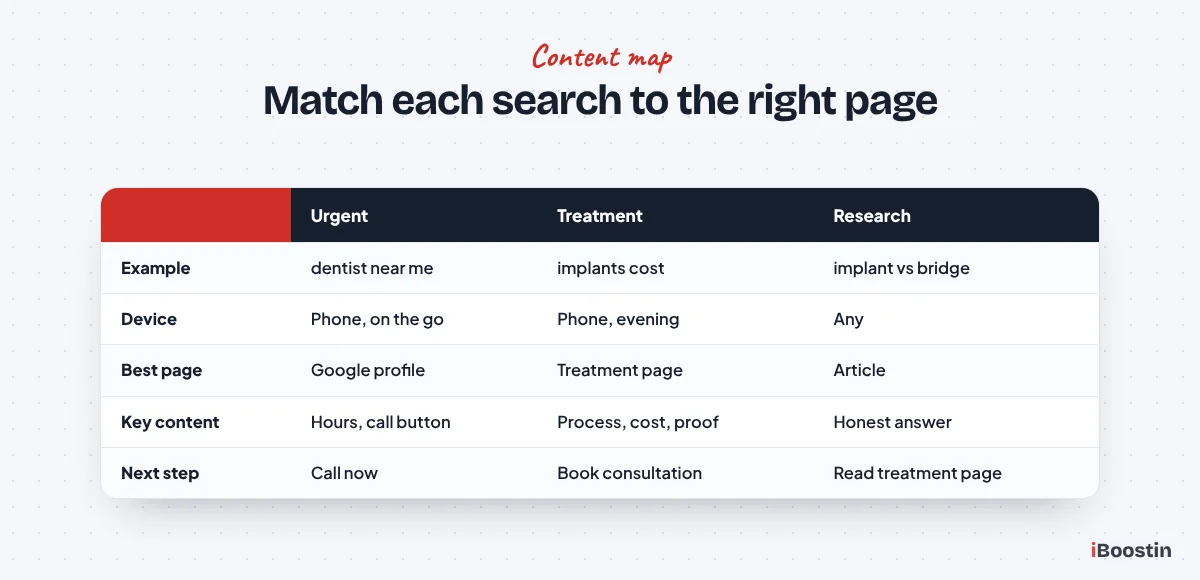
Patients search in three broad ways. The first is the urgent search: “emergency dentist”, “toothache dentist open now” or “dentist near me” typed on a phone, often from the street outside. The second is the treatment search: “dental implants cost”, “Invisalign near me” or “teeth whitening” plus a town name, usually done on a phone in the evening while comparing options. The third is the research search: “how long do veneers last”, “is a root canal painful” or “implant vs bridge”, done by someone who is worried, curious or still deciding.
Each type needs a different answer. Urgent searches are won in the map pack and with a click-to-call button. Treatment searches are won with detailed treatment pages that answer cost, process and recovery questions. Research searches are won with helpful articles that build trust and lead, gently, to a consultation. A dental SEO plan that only targets “dentist” plus the town name misses most of the patients who would choose you.
Why dental SEO is different from other local SEO
Google treats dental and medical content as “your money or your life” content, because bad advice can harm someone. That means it looks harder for signs that the information comes from qualified people, is accurate and is kept up to date. A plumber’s website can rank with friendly copy and good reviews. A dental website also needs named dentists with their qualifications, careful treatment explanations and clear information about risks and recovery.
Dental searches are also highly local and highly competitive. In most towns, several practices, a few corporate chains and directories all compete for the same handful of map pack places. The practices that win are rarely the biggest. They are the ones with the most complete profile, the most relevant pages and the steadiest stream of genuine reviews.
Start With Your Google Business Profile
Why the map pack brings most new patients
For “dentist near me” and similar searches, Google shows a map with three practices above the normal results. On a phone, those three listings fill most of the screen, and many patients call straight from the listing without ever visiting a website. If your practice is not in those three places for the searches near you, most urgent and local patients never see you.
The map pack is decided mostly by three things: how relevant your profile is to the search, how close the searcher is, and how prominent your practice looks online. You cannot change distance, but you can control relevance and prominence, and that is where the work goes. Our guide on how to rank higher on Google Maps covers the general method in detail; the steps below are the dental version.
What a complete dental profile looks like
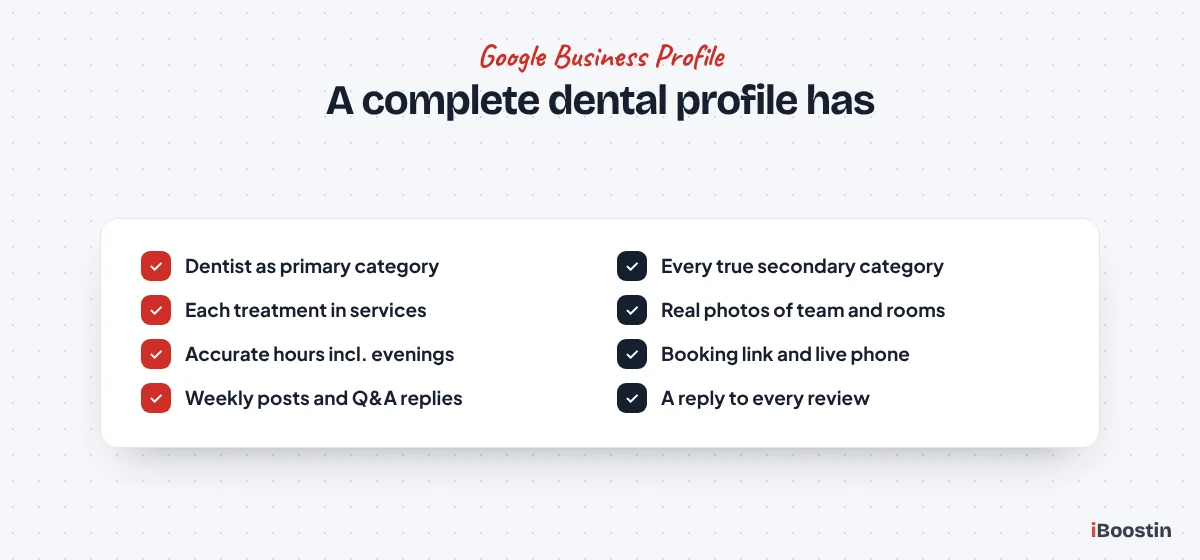
Choose “Dentist” as your primary category, then add every secondary category that truly applies, such as “Cosmetic dentist”, “Dental implants periodontist”, “Emergency dental service”, “Orthodontist” or “Pediatric dentist”. Categories are one of the strongest relevance signals, and many practices leave them at a single generic choice.
Fill in the services section with each treatment and a short description. Add opening hours, including any evening or weekend sessions, and mark holiday hours ahead of time. Upload real photos: the outside of the building so patients recognise it, the reception, treatment rooms, equipment and the team. Add the booking link, the phone number that is actually answered, accessibility details and parking information.
Then keep it alive. Post updates about new treatments, seasonal offers or new team members, answer questions in the Q&A section yourself, and reply to every review. An active profile signals to Google that the practice is real and open.
Keep your practice details identical everywhere
Your practice name, address and phone number should be exactly the same on your website, Google profile, Bing Places, Apple Maps, Facebook, Yelp and the main dental directories in your country. Small differences, such as an old phone number or “Street” in one place and “St” in another, weaken the trust Google places in your location.
If the practice has moved, changed its name or merged with another, search for the old details and update every listing you can find. This is slow, unglamorous work, but it often removes the hidden reason a good practice cannot reach the top three.
Build One Strong Page for Every Treatment
Why a single services page holds you back
When all your treatments sit on one page, Google cannot tell which treatment the page is about, so it struggles to rank it for any of them. Patients have the same problem: someone researching implants does not want to scroll past whitening and fillings to find three lines about the treatment that costs them the most.
A dedicated page for each major treatment solves both problems. It lets the page match one search intent, answer the questions behind it in depth and lead to one clear action. In our experience this single change, splitting one services page into proper treatment pages, is the biggest on-site improvement most dental websites can make.
Which treatment pages to create first
Start with the treatments that bring the most value to the practice and the most search demand in your area. For most general and cosmetic practices that means dental implants, clear aligners such as Invisalign, veneers, teeth whitening, emergency dentistry, root canal treatment, children’s dentistry and general check-ups and hygiene.
Then add pages for treatments where you have a real specialty or a strong local reputation: sedation dentistry for nervous patients, full-mouth rehabilitation, gum treatment or orthodontics. A specialty page often ranks faster because fewer competitors have one.
What a dental treatment page should include
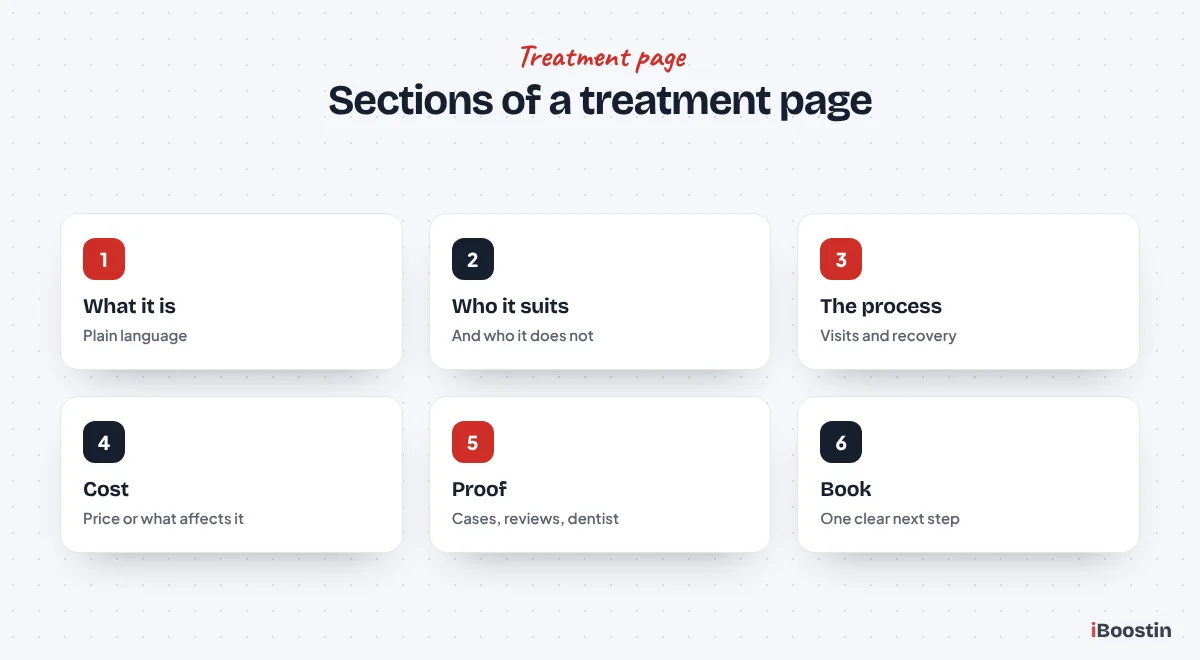
A strong treatment page answers what a patient would ask in a consultation. Explain what the treatment is in plain language, who it is suitable for and who it is not. Describe the process step by step, how many visits it takes and what recovery feels like. Cover the risks honestly and explain how you reduce them.
Address cost directly. If you can publish a starting price or a range, do so; if not, explain what affects the price and whether you offer finance or payment plans. Patients searching “implants cost” leave pages that dodge the question.
Add proof: before-and-after photos with patient consent, short case notes, reviews that mention the treatment and the name and qualifications of the dentist who performs it. Finish with frequently asked questions and one clear call to action, such as booking a consultation, so the page ends with a next step rather than a dead end.
Location pages for practices with several branches
If you run more than one practice, each branch needs its own page with its own address, opening hours, team, photos, parking and directions, plus a link to its own Google profile. Avoid copying the same text and swapping the town name; Google treats near-identical location pages as low value. Write about what is genuinely different at each branch: the dentists there, the treatments offered, the area it serves.
Link each branch page to its own Google Business Profile and make sure the profile links back to that page, not the homepage. This simple pairing helps Google connect the right listing with the right location and stops branches from competing with each other for the same searches.
Show Google and Patients You Can Be Trusted
Named dentists and real credentials
Every dental website should have a page for each dentist and hygienist with their full name, photo, qualifications, registration details, areas of interest and years of experience. Link treatment pages to the dentist who performs the treatment. This is not decoration. It is exactly the kind of experience and expertise signal that Google looks for on health content, and patients read these pages more than most practices expect.
Mark up each dentist with schema so search engines can connect the person, the practice and the treatments. Keep the details current; an outdated team page with dentists who left two years ago undermines trust quickly.
Accurate, reviewed health information
Treatment explanations and articles should be accurate, specific and reviewed by a qualified dentist. Add a short “reviewed by” line with the dentist’s name and the date it was last checked. Avoid exaggerated claims such as “painless” or “permanent” unless they are clinically accurate, and avoid promising results. Careful wording protects the practice and reads as more credible to patients who are already nervous.
Where you mention statistics, success rates or materials, keep them general unless you can support them with your own clinical experience or a recognised professional body. If a treatment carries a known risk, say so and explain how your team manages it. Honest pages convert better than glossy ones, because patients can tell when they are being sold to.
Technical basics that matter for a practice website
Most dental searches happen on phones, often in a hurry. The site needs to load quickly on mobile data, show the phone number and booking button without scrolling, and work properly on every screen size. Check speed and Core Web Vitals, make sure every treatment page can be indexed, fix broken links from old pages and use HTTPS everywhere.
Add dental practice and local business schema with your address, hours, phone number and services, and FAQ schema where you have real questions and answers. If your booking system lives on another domain, make sure the booking link works and that you can still track bookings back to search.
Reviews: The Fastest Lever for Dental Practices
Why reviews matter so much for dentists
Choosing a dentist is personal and often stressful. Patients read reviews to find out whether the dentist is gentle, whether the staff are kind and whether the practice explains costs honestly. A practice with many recent, detailed reviews looks safer than one with a handful of old ones, even if the second practice is just as good.
Reviews also feed rankings. The number of reviews, how recent they are, the overall rating and the words patients use all help Google understand what the practice is known for. A review that mentions “implants” or “emergency appointment” adds relevance for those searches.
A simple routine for getting more reviews
The practices with the most reviews almost always have a routine, not a campaign. After a positive appointment, the receptionist mentions that reviews help other patients find the practice, and the patient receives a short text or email with a direct link to the Google review form. Ask every happy patient, every week, without incentives and without filtering only the happy ones.
Reply to every review within a few days. Thank positive reviewers by name without mentioning their treatment, which protects their privacy. Respond to negative reviews calmly, without sharing clinical details, and offer to continue the conversation privately. Prospective patients read the replies as much as the reviews.
What to avoid
Never buy reviews, write reviews for patients or offer discounts in exchange for them. Fake or incentivised reviews can lead to reviews being removed, a profile being suspended or, in some countries, regulatory trouble. A steady trickle of genuine reviews is safer and more convincing than a sudden burst of suspicious five-star ratings.
Also avoid gating reviews, which means only sending review requests to patients you think are happy. Google’s guidelines ask businesses not to discourage or selectively solicit reviews, and patients notice when every review sounds the same. A natural mix of detailed, honest reviews is what earns trust over time.
Content That Brings Patients Who Are Still Deciding
Answer the questions patients ask before they book
Many future patients start with a question, not a search for a practice. They want to know whether implants hurt, how long Invisalign takes, whether whitening damages enamel or what to do about a chipped tooth on a weekend. Articles that answer these questions clearly and honestly bring visitors who are early in their decision and give them a reason to remember your practice.
Write about the questions you hear in the chair every week. Each article should give a genuinely useful answer, link to the relevant treatment page and invite the reader to book a consultation if they want a personal answer. Avoid writing generic health content with no connection to the treatments you offer; it rarely brings patients.
Cost and comparison content
Patients search for comparisons constantly: implants versus bridges, veneers versus bonding, clear aligners versus braces, private versus insurance-covered treatment. A fair comparison that explains pros, cons, suitability and typical cost factors helps patients decide and positions your dentists as the trustworthy option. It also tends to rank well because many practices avoid these topics.
Keep comparisons balanced. If a cheaper option suits some patients better, say so. Readers who feel they got an honest answer are far more likely to book a consultation, and a balanced article is easier to link to from other health and local websites than a page that only promotes one treatment.
Keep content fresh and reviewed
Health content ages. Review your treatment pages and articles at least once a year, update prices, equipment, techniques and team details, and record the review date on the page. Remove or merge thin old blog posts that no longer help anyone. A smaller set of accurate, regularly reviewed pages beats a large archive of outdated ones.
A simple annual content calendar works well for most practices: review treatment pages before the busy seasons, update team pages whenever staff change and refresh cost information whenever your prices move. Note each review in a shared document so nothing is forgotten when the person who wrote the page moves on.
Links and Mentions That Build Authority
Local and professional sources
Dental practices earn authority from sources that are relevant and local. Good starting points include membership listings with professional dental associations, local business directories, sponsorship of school or sports events, local news coverage of community work and partnerships with nearby healthcare providers. Each one tells Google that a real, respected practice exists at your address.
Dentists with a special interest can also earn links by contributing expert comments to local media, writing for health websites or speaking at events. These links are slower to earn but carry real weight, because they come from sources that do not link to just anyone.
Links to avoid
Avoid paid link packages, private blog networks and directories that exist only to sell links. They rarely help and can harm the domain. A few genuine links from local and professional sources do more than hundreds of low-quality ones.
Be careful with directories that charge for a listing but have no real visitors, and with guest post offers that promise links from unrelated websites. If an offer arrives by email promising dozens of links for a small fee, the links are almost certainly from networks that Google already ignores or penalises.
Get Your Practice Recommended in AI Search
How AI answers choose which practices to name
More patients now ask ChatGPT, Google AI Overviews or other assistants questions such as “which dentist near me is good for nervous patients”. These tools tend to recommend practices that are clearly described online, consistently listed and well reviewed, and that publish specific, accurate information about their treatments and dentists.
AI tools also draw on reviews and third-party mentions, so a practice that is discussed in local news, listed accurately in dental directories and reviewed in detail on Google has a better chance of being named. Thin or inconsistent information makes it harder for any tool to recommend you confidently.
Practical steps you can take
Make sure your website states plainly who you are, where you are, which treatments you offer and who your dentists are. Use the same practice description on your website, Google profile and main directories. Publish clear answers to common patient questions on your treatment pages, and keep your reviews flowing. Schema for the practice, dentists, services and FAQs helps machines read all of this correctly. The work overlaps almost entirely with good SEO, which is why it is worth doing now.
Finally, test it yourself. Ask a few AI assistants which dentists they recommend in your area for the treatments you offer, note who they name and what they say, and compare it with how your own practice is described online. The gaps you find are usually the same gaps that hold back your normal search rankings.
Measure Dental SEO in Appointments, Not Rankings
The numbers worth tracking
Rankings are useful signals, but the practice pays bills with appointments. Track phone calls from your Google profile and website, online booking requests, contact form submissions and WhatsApp or message enquiries, and record which treatment each enquiry is about. In Search Console, watch impressions and clicks for treatment searches; in your profile insights, watch calls, website clicks and direction requests.
Use call tracking numbers on the website if you can, set up conversion tracking for booking clicks and form submissions in Analytics, and ask new patients how they found you. Even a simple tally at reception gives you a clearer picture than rankings alone.
How long dental SEO takes
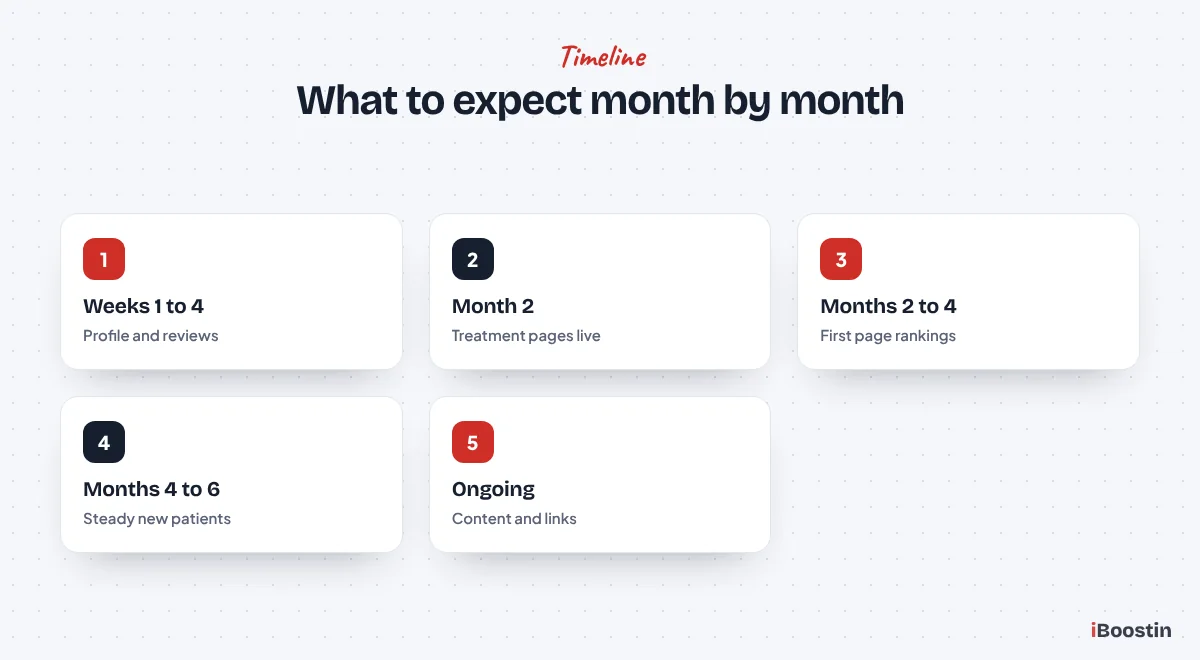
Profile improvements and review routines can move map pack visibility within weeks. New treatment pages usually start ranking within two to four months, faster for specialties with little competition and slower for busy treatments such as implants in large cities. Our guide on how long SEO takes explains the general timeline and what speeds it up.
The biggest factor is how strong the competition is in your area. A practice in a small town with few competitors can reach the map pack quickly, while a practice in a large city competing with chains and specialist clinics needs more content, more reviews and more links. Planning for six months of steady work avoids disappointment and gives the results time to compound.
Common Dental SEO Mistakes
One page for every treatment
Listing all treatments on one page is the most common and most costly mistake. Patients cannot find detail, and Google cannot match the page to specific searches. Split it.
The fix does not have to happen all at once. Start with the two or three treatments that bring the most value, build proper pages for them and link to them from the homepage and the main menu. Add the rest over the following months as part of your regular content work.
Stock photos and anonymous dentists
Stock photos of smiling models and a team page without names tell patients and Google nothing. Real photos of your team, rooms and results build trust and support rankings.
Patients choosing a dentist want to see the person who will treat them and the room they will sit in. A short professional photo shoot of your team and practice is one of the best investments a dental website can make, and the photos can be reused on your Google profile and social media.
Ignoring reviews and the profile
A profile set up once and then forgotten slowly loses ground to competitors who post, update and collect reviews every week. The profile needs a little attention every month.
Set a recurring reminder for someone on the team to check the profile every week: answer new questions, reply to new reviews, add a post and confirm the hours are still correct. Fifteen minutes a week is usually enough to keep the profile ahead of competitors who never touch theirs.
Choosing an agency that promises the top spot
No one can guarantee a position on Google, and anyone who promises it is usually relying on risky shortcuts. Ask any agency what they will do each month, how they report and who owns your accounts. Our guide on how to choose an SEO company lists the questions that separate real work from sales talk.
Also ask how the agency will measure success. If the answer is only rankings, keep looking. A good dental SEO partner reports on calls, booking requests and the treatments those enquiries are about, because that is what tells you whether the work is paying for itself.
Doing Dental SEO Yourself vs Getting Help
What you can do in-house
A practice manager or a team member who enjoys this work can handle a lot: keeping the Google profile updated, running the review routine, replying to reviews, collecting photos and checking that the phone number and hours are correct everywhere. These tasks take an hour or two a week and make a real difference.
Give one person clear ownership of these tasks and a simple monthly checklist. When everyone assumes someone else is replying to reviews or updating the hours, nobody does, and the profile slowly falls behind.
When it pays to bring in a specialist
Treatment pages, technical fixes, schema, content strategy and link building take more time and skill. If your practice is in a competitive area, has several branches or wants to grow a high-value treatment such as implants or aligners, a specialist usually pays back quickly. Our monthly SEO services cover this work with a clear task list each month, and our local SEO services focus on the map pack and profile work that brings the fastest new patient calls.
The best arrangement for many practices is a split: the team handles reviews and the profile day to day, while a specialist handles pages, technical work and links. That keeps costs sensible and makes sure the work that needs experience is done properly.
Frequently Asked Questions About SEO for Dentists
How do dentists get more patients from Google?
Most new patients come from the map pack and treatment searches. Complete and maintain your Google Business Profile, create a detailed page for each major treatment, collect genuine reviews steadily and make your website fast and easy to book from on a phone.
What is the most important part of dental SEO?
For most practices it is the Google Business Profile combined with reviews, because that decides whether you appear in the map pack for “dentist near me” searches. Treatment pages come next, because they win the higher-value treatment searches.
How long does SEO take for a dental practice?
Profile and review improvements can show results within weeks. Treatment pages usually start ranking within two to four months, and competitive treatments in large cities can take six months or more of steady work.
Should every treatment have its own page?
Yes. A dedicated page for each major treatment lets you answer patients’ questions in depth and gives Google a clear page to rank for each treatment search. One combined services page rarely ranks well for anything.
Can I publish prices on my dental website?
Where your regulations allow it, publishing starting prices or ranges builds trust and helps treatment pages rank for cost searches. If you cannot publish exact prices, explain what affects the cost and whether finance is available.
How do I get more Google reviews for my practice?
Ask every satisfied patient after their appointment and send a direct link to your review form by text or email. Reply to every review, and never buy reviews or offer incentives for them.
Does AI search affect dental practices?
Yes, increasingly. AI assistants recommend practices that are clearly described, consistently listed and well reviewed. The same work that helps your SEO, especially accurate treatment pages and reviews, helps AI tools recommend you.
Is paid advertising better than SEO for dentists?
Ads bring patients immediately but stop when you stop paying. SEO takes longer but keeps bringing patients from your profile and treatment pages. Many practices use ads for high-value treatments while their SEO builds, then reduce ad spend as organic bookings grow.
Start Where Your Next Patients Are Searching
The practices that win in search are rarely the biggest or the oldest. They are the ones that look after their Google profile, explain every treatment properly, show who their dentists are and ask happy patients for reviews, every single week. Start with the profile and your most valuable treatment page, measure the calls and bookings that follow, and build from there. If you would like a second opinion on where your practice stands today, send us your website and we will tell you what we would fix first.